
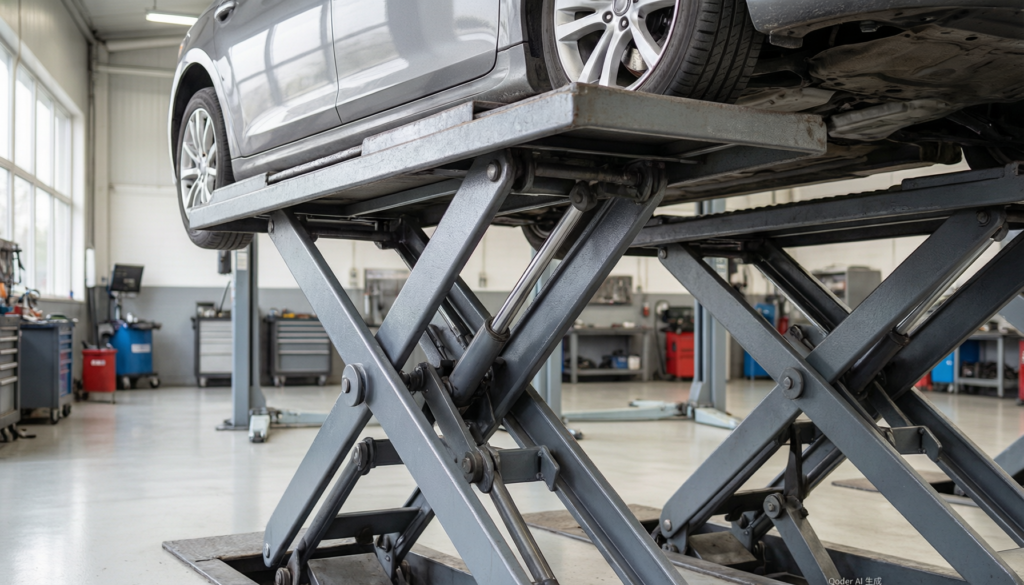
Selecting the right car lift capacity starts with understanding what your workshop actually lifts—not just the heaviest vehicle you service, but how that weight distributes across the platform, where the lifting points sit, and whether the machine’s physical dimensions match your target vehicle range.
This guide walks through the calculation process: from rated capacity definitions to vehicle weight data, load distribution patterns, lifting-point positions, platform coverage, and ground clearance. The goal is to help you submit accurate specifications when requesting a quotation, reducing the risk of ordering a lift that fits the weight on paper but fails in daily use.
What Does Rated Car Lift Capacity Mean?
Rated capacity is the maximum weight a lift is designed to handle under specific test conditions. It does not automatically translate to every vehicle within that weight range.
Manufacturers assign a rated capacity based on standardized load tests—typically with the weight centered on the platform or evenly distributed across lifting arms. In der Praxis, vehicles rarely load a lift symmetrically. A front-engine sedan concentrates more mass over the front axle; a rear-engine sports car shifts the balance backward; a loaded pickup or van adds payload weight that changes the distribution entirely.
The rated capacity also assumes proper use of lifting points. If the vehicle’s designated lift points fall outside the platform’s adjustable range, or if the arms cannot reach the correct structural locations, the machine may be operating beyond its intended geometry—even if the total weight is within limits.
Always treat the rated capacity as a starting point, not a final answer. The next step is matching that number to your actual vehicle mix and service requirements.
List the Vehicles and Services the Lift Must Cover
Before comparing lift models, document the full range of vehicles and services your workshop handles. This list becomes the baseline for capacity and dimension calculations.
Start with vehicle types: passenger cars, SUVs, light commercial vans, pickup trucks, or specialty vehicles. For each category, note the curb weight (empty vehicle) and the maximum operating weight (vehicle with fuel, tools, cargo, or passengers if applicable). A delivery van may weigh 2,500 kg empty but reach 3,500 kg when loaded—and your lift must handle both states.
Nächste, list the services you plan to perform. Brake work requires the wheels to hang free; suspension service may need full extension; exhaust work demands clearance under the vehicle; tire rotation needs platform access. Each service affects how the vehicle sits on the lift and whether the machine’s height range and platform design support the work.
If you operate a mixed-use workshop—serving both passenger cars and light trucks—the lift must accommodate the full spectrum. A machine rated for 3,000 kg may handle most sedans but fall short if a loaded pickup exceeds that threshold or if the platform length cannot support a long-wheelbase van.
Compare Vehicle Weight, Load Distribution, and Operating Condition
Vehicle weight alone does not determine lift compatibility. You must also consider how that weight distributes across the axles and whether the vehicle is empty, loaded, or mid-service.
Most passenger vehicles have a front-to-rear weight distribution between 55/45 Und 60/40, meaning slightly more mass sits over the front axle. For a 1,800 kg sedan, this translates to roughly 1,000 kg on the front and 800 kg on the rear. If your lift’s arms or platform cannot support this uneven loading, the machine may strain or tilt during operation.
Commercial vehicles often have more extreme distributions. A rear-wheel-drive pickup with a loaded bed may shift 70% of its weight to the rear axle. A front-wheel-drive van with cargo behind the front seats concentrates mass forward. The lift must handle these imbalances without exceeding its rated capacity on any single arm or platform section.
Operating condition matters as well. A vehicle on the lift for brake service has no wheels attached, reducing total weight but changing the center of gravity. A vehicle mid-engine repair may have components removed, altering the balance. Always calculate capacity based on the heaviest realistic scenario—typically a fully loaded vehicle in normal service condition.
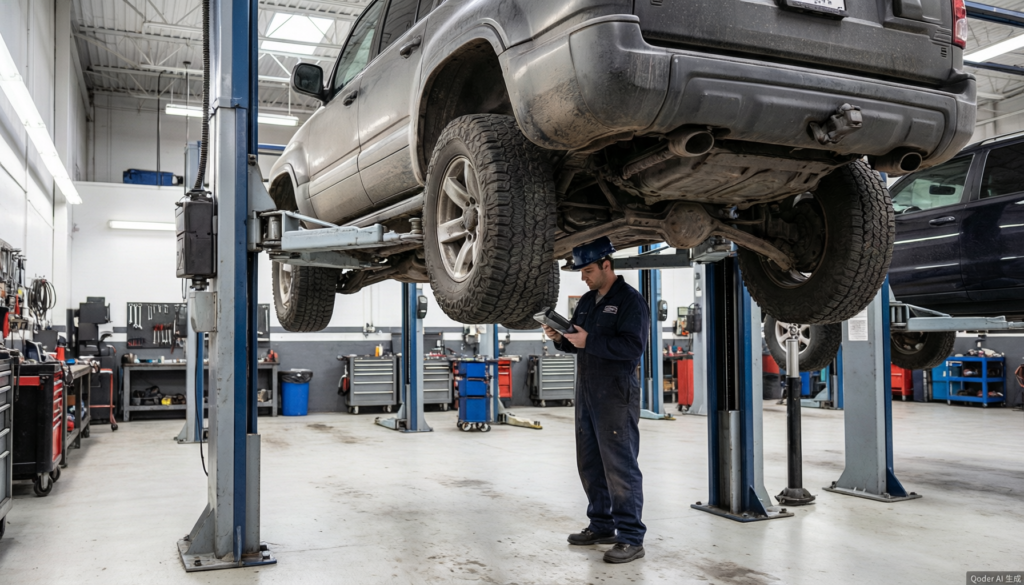
Check Lifting Points, Platform Range, and Ground Clearance
Even if a lift can handle the weight, it must physically reach the vehicle’s designated lifting points and provide adequate ground clearance for your service work.
Modern vehicles have specific lifting points—reinforced locations on the frame, subframe, or rocker panels—designed to support the vehicle’s weight during service. These points vary by make, model, and year. A lift with adjustable arms or adapters can accommodate a wider range of vehicles; a fixed-platform lift may only work for certain wheelbase lengths or vehicle types.
Platform dimensions—length, width, and height range—must match your target vehicles. A compact car may fit on a 4-meter platform, but a long-wheelbase van or dual-rear-wheel pickup needs 5 meters or more. Platform width affects stability, especially for vehicles with wide track widths or aftermarket wheels. The collapsed height (how low the platform sits) determines whether you can drive low-clearance sports cars onto the lift without scraping.
Ground clearance under the vehicle is critical for underbody work. If you service exhaust systems, transmissions, or fuel tanks, the lift must raise the vehicle high enough to provide access. Some scissor lifts or low-rise platforms may not achieve the necessary height, forcing you to use additional equipment or turn away certain jobs.
Match Lift Capacity to Cars, SUVs, and Light Commercial Vehicles
With vehicle data in hand, compare it against lift specifications to find machines that cover your full range—not just the average case.
Start by identifying the heaviest vehicle in your mix and its maximum operating weight. This becomes your minimum capacity requirement. If you service a mix of 1,500 kg sedans and 3,200 kg loaded vans, the lift must handle at least 3,200 kg—and ideally more, to account for uneven loading or future vehicle additions.
Nächste, check the platform dimensions against your longest and widest vehicles. A 5.2-meter van needs a platform at least that length; a dual-rear-wheel pickup with 2.5-meter track width needs adequate platform width for stability. If the lift’s standard platform is too short, check whether extensions are available.
Finally, verify the lifting height range. If you perform underbody work, the lift must raise the vehicle high enough for access. If you service low-clearance vehicles, the platform must collapse low enough for drive-on access without scraping. Some lifts offer adjustable height settings; others have fixed limits.
For workshops handling a diverse vehicle mix, consider whether the lift’s adapter system can accommodate different chassis designs. Passenger cars often use rocker-panel lift points; SUVs and trucks may require frame-contact adapters; unibody vehicles need specific pad positions to avoid damaging structural panels. A lift with a flexible adapter range reduces the need for multiple machines or aftermarket modifications.
Why the Highest-Capacity Lift Is Not Always the Best Choice
Selecting a lift with excessive capacity may seem like a safety margin, but it can introduce inefficiencies in cost, space, and daily operation.
Higher-capacity lifts typically cost more—not just in purchase price, but in installation requirements (stronger floor anchoring, heavier-duty electrical supply), maintenance (larger hydraulic systems, more robust components), and energy consumption. If your workshop rarely exceeds 3,000 kg, a 5,000 kg lift may be unnecessary overhead.
Physical footprint is another consideration. A heavy-duty lift often has a larger platform, wider base, or taller structure. In a compact workshop, this may reduce usable space for other equipment, vehicle movement, or storage. The lift must fit your facility, not just your vehicle range.
Finally, operating speed and precision may differ. Larger hydraulic systems can be slower to raise or lower, and heavier platforms may be less responsive when positioning vehicles for detailed work. If your workflow prioritizes quick turnaround on passenger cars, a smaller, faster lift may be more productive than a slower, higher-capacity machine.
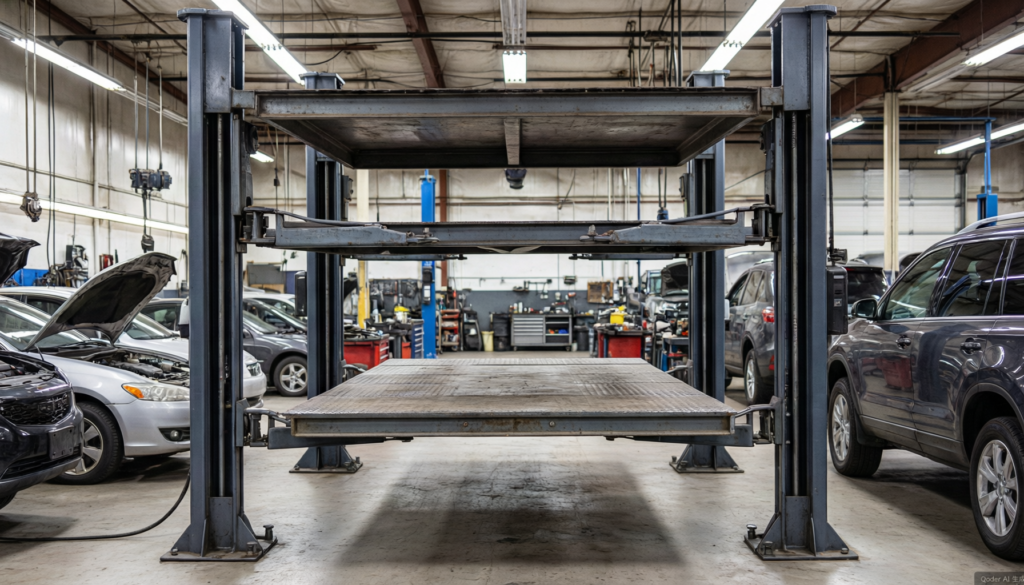
Car Lift Capacity Checklist for an RFQ
Use this checklist to compile the information suppliers need to quote the right lift for your workshop.
| Item | What to Specify |
|---|---|
| Vehicle types | List all categories: passenger cars, SUVs, Transporter, pickups, specialty vehicles. |
| Weight range | Curb weight and maximum operating weight for each vehicle type. |
| Load distribution | Front-to-rear weight split if known, especially for rear-heavy vehicles. |
| Lifting points | Vehicle-specific lift point locations; confirm adapter compatibility. |
| Platform dimensions | Length, width, and collapsed height requirements for your longest and lowest vehicles. |
| Lifting height | Maximum height needed for underbody work; minimum height for drive-on access. |
| Services performed | Brake, suspension, exhaust, tire, or general maintenance—affects height and access needs. |
| Workshop constraints | Floor space, ceiling height, electrical supply, and anchoring requirements. |
When you send this information to suppliers, they can match your requirements to specific models rather than offering generic capacity ranges. This reduces back-and-forth and helps you compare quotations on equal terms.
If you’re also evaluating lift types (two-post, four-post, scissor, or in-ground), our guide to choosing the right vehicle lift covers the structural and workflow differences between designs. The capacity calculation process applies across all lift types—but the platform geometry and lifting-point access vary significantly by design.
Häufig gestellte Fragen
What car lift capacity do I need?
Identify the heaviest vehicle in your mix (including operating weight with cargo or payload) and select a lift with a rated capacity exceeding that number. Also verify that the platform dimensions, lifting-point range, and height coverage match your target vehicles and services.
Can one lift handle both cars and SUVs?
Ja, if the lift’s capacity covers the heavier SUV and the platform dimensions accommodate both vehicle lengths. Verify that the lifting-point range and adapter options work for both car and SUV chassis designs.
Why does vehicle weight distribution matter?
Uneven weight distribution affects how the load transfers to the lift’s arms or platform. A lift rated for 3,000 kg may struggle if 70% of that weight sits over one axle and the arms cannot support that concentration. Always check both total capacity and load distribution limits.
Is a higher-capacity lift always better?
Not necessarily. Higher-capacity lifts cost more, take up more space, and may operate more slowly. If your workshop rarely exceeds a certain weight, a lift sized for that range—with modest headroom—is often more efficient than an oversized machine.
What vehicle data should be included in a lift RFQ?
Provide vehicle types, curb and operating weights, load distribution patterns, lifting-point locations, platform dimension requirements, desired lifting height, services performed, and workshop constraints (floor space, ceiling height, electrical supply). This allows suppliers to match specific models rather than offering generic capacity ranges.
Letzte Gedanken
Choosing the right car lift capacity is not about finding the highest number—it’s about matching the machine to your actual vehicle range, service requirements, and workshop conditions. A lift that fits your heaviest vehicle but cannot reach its lifting points, or one that handles the weight but lacks the platform dimensions for your longest van, will create operational friction from day one.
Use the checklist above to compile your requirements before requesting quotations. When suppliers have complete vehicle and application data, they can recommend specific models rather than offering generic capacity ranges—and you can compare proposals on equal terms.
Browse our car lift selection to see how different capacity ranges and platform configurations align with common workshop profiles. If you need help matching your vehicle data to a specific model, our team can review your requirements and suggest options that fit both your current needs and future growth.


