
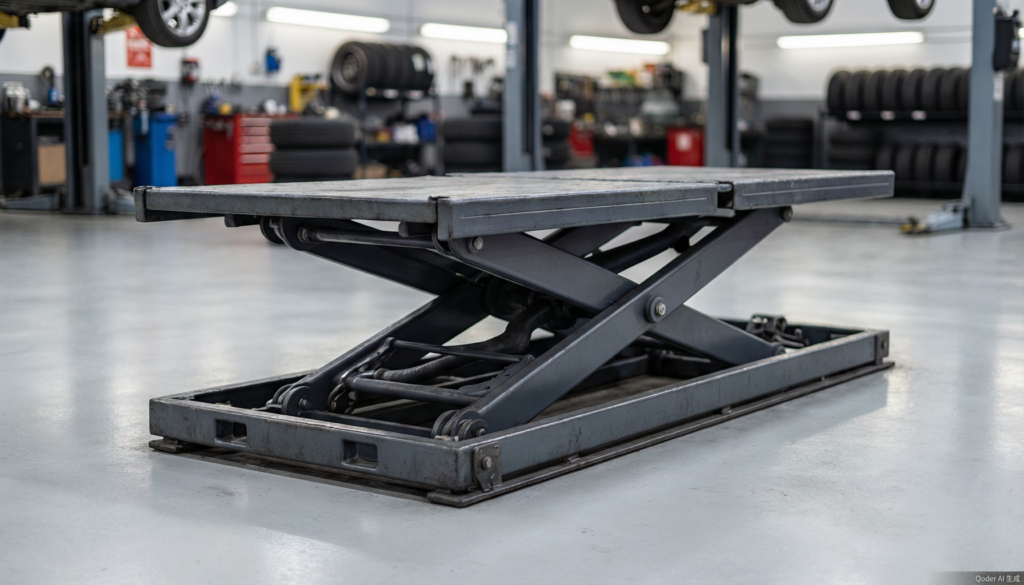
Scissor lifts are classified by two independent dimensions: mobility (portable vs. fixed) and lifting height (low-rise vs. mid-rise). These classifications overlap—a lift can be both portable and mid-rise, or fixed and low-rise. Understanding both dimensions helps you match the lift to your workshop’s space, vehicle range, e requisitos de serviço.
This guide compares portable, low-rise, and mid-rise scissor lifts across lifting height, collapsed height, working access, vehicle compatibility, installation requirements, and safety functions. The goal is to help you evaluate lifts based on your specific application rather than assuming that shop size alone determines the correct choice.
Why Mobility and Lifting Height Are Different Classification Dimensions
Portable and mid-rise are not opposing categories. Portability describes whether the lift can be moved; lifting height describes how high the platform rises. A lift can be portable and mid-rise, portable and low-rise, fixed and mid-rise, or fixed and low-rise.
Mobility (portable vs. fixed) refers to whether the lift has wheels or a movable frame that allows it to be repositioned within the workshop or transported to different locations. Portable lifts can be moved as needed; fixed lifts are anchored to the floor and remain in one location.
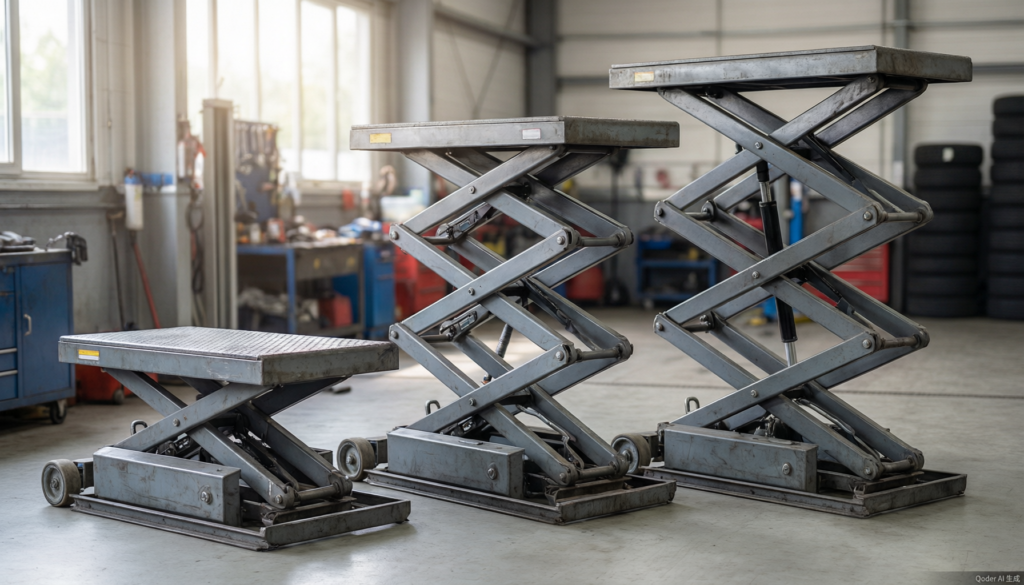
Lifting height (low-rise vs. mid-rise) refers to how high the platform rises above the ground. Low-rise lifts typically lift 300–700 mm (12–28 inches); mid-rise lifts typically lift 700–1,500 mm (28–60 inches) or more. The lifting height determines what work you can perform under the vehicle.
These two dimensions are independent. You must evaluate both when selecting a lift. A portable low-rise lift serves different applications than a fixed mid-rise lift, but a portable mid-rise lift is also possible. Do not assume that portability and lifting height are mutually exclusive.
Portable, Low-Rise, and Mid-Rise Scissor Lift Designs
Each lift type has distinct design characteristics that affect its portability, lifting height, and application suitability.
| Design | Weight | Lift Height | Platform Length | Key Characteristic |
|---|---|---|---|---|
| Portable low-rise | 50–150 kg | 300–500 mm (12–20″) | 1,000–1,500 mm | Wheels/casters; fits in a van; quick repositioning within or between sites |
| Portable mid-rise | 150–400 kg | 700–1,200 mm (28–48″) | 1,500–2,500 mm | Movable but requires more effort; some disassemble for transport in a large van |
| Fixed low-rise | Varies (anchored) | 300–700 mm (12–28″) | 1,200–2,000 mm | Permanent floor anchor; stable but not flexible |
| Fixed mid-rise | 400–1,000+ kg | 1,000–1,800 mm (40–72″) | 2,000–3,000+ mm | Professional workshop bay; maximum height and stability for heavy service work |
Explore the scissor lift product range to compare lifting heights and platform sizes across portable and fixed models.
Compare Lifting Height, Collapsed Height, and Working Access
Lifting height determines what work you can perform under the vehicle; collapsed height determines whether low-clearance vehicles can drive onto the lift.
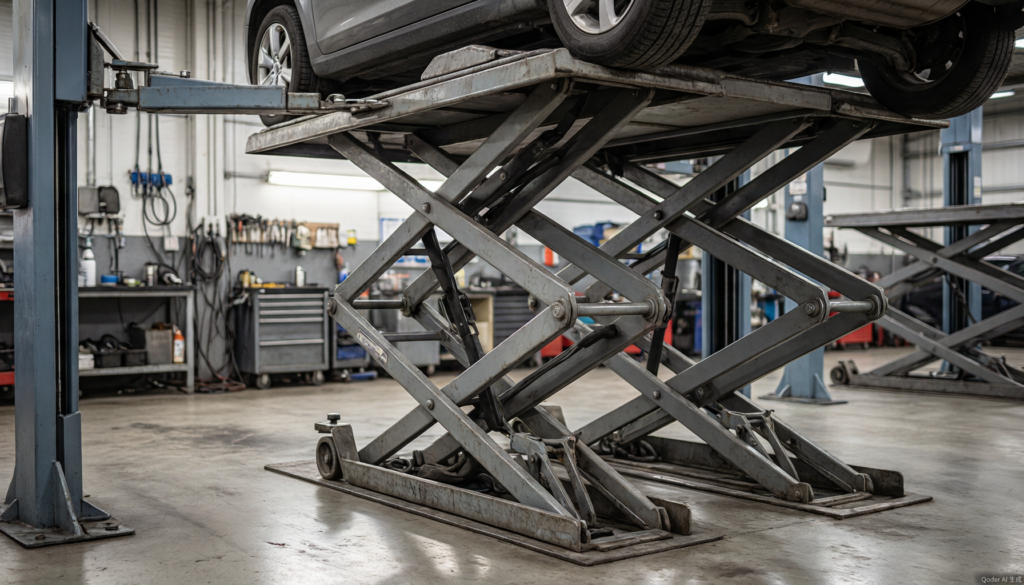
Lifting height is the maximum distance the platform rises above the ground. Low-rise lifts (300–700 mm) provide enough clearance for tire rotation, basic brake inspection, and undercarriage visual checks. Mid-rise lifts (700–1,800 mm) provide full access for brake service, suspension work, exhaust repair, and detailed undercarriage inspection.
Collapsed height is how low the platform sits when the lift is fully lowered. This determines whether low-clearance vehicles (sports cars, modified sedans) can drive onto the lift without scraping. Low-rise lifts typically have collapsed heights of 100–150 mm (4–6 inches); mid-rise lifts may have collapsed heights of 150–250 mm (6–10 inches). If you service low-clearance vehicles, verify that the collapsed height is acceptable.
Working access refers to how easily you can reach the vehicle’s undercarriage, wheels, and brake components. Mid-rise lifts provide better access than low-rise lifts because the vehicle is higher, allowing the technician to work standing up rather than crouching or lying on the ground. No entanto, mid-rise lifts may have central underbody obstructions (the scissor mechanism or platform supports) that limit access to certain areas.
Match Each Design to Tire, Brake, Body, and General Repair Work
Different service tasks require different lifting heights and access levels. Match the lift design to your primary service applications.
| Service Task | What It Requires | Suitable Lift | Note |
|---|---|---|---|
| Tire service | Wheels hang free for rotation/balancing/replacement | Low-rise (rotation) or mid-rise (full tire changes) | Portable low-rise for mobile service; fixed mid-rise for high-volume shops |
| Brake service | Wheel removal + access to calipers, rotors, lines | Mid-rise strongly recommended | Low-rise may suffice for basic pads but limits standing access |
| Body work | Access to underside and wheel wells | Mid-rise minimum; full-rise for major work | Low-rise provides insufficient clearance for panel or undercoating work |
| General repair | Full undercarriage access (suspension, exhaust, transmission) | Mid-rise as minimum; full-rise for transmission/exhaust | Some jobs exceed mid-rise capability regardless of configuration |
For a broader comparison of lift categories including two-post and four-post options, read our vehicle lift types guide e how to evaluate a car lift manufacturer.
Vehicle Ground Clearance, Lifting Points, and Platform Coverage
The lift must accommodate your target vehicles’ ground clearance, lifting points, and platform coverage requirements.
Vehicle ground clearance is the distance between the ground and the lowest point of the vehicle’s undercarriage. Low-clearance vehicles (sports cars, modified sedans) may have only 100–150 mm of ground clearance. The lift’s collapsed height must be lower than the vehicle’s ground clearance to allow drive-on access. If the collapsed height is too high, the vehicle will scrape on the platform during drive-on.
Lifting points are the designated locations on the vehicle’s frame, subframe, or rocker panels where the lift contacts the vehicle. Different vehicles have different lifting point configurations. The lift’s platform or adapters must reach these points without contacting other parts of the vehicle. Some lifts offer adjustable adapters or extension arms to accommodate different lifting point positions.
Platform coverage refers to the length and width of the lift’s platform. The platform must be long enough to support the vehicle’s wheelbase and wide enough to support the vehicle’s track width. Compact cars may fit on platforms of 1,500–2,000 mm; SUVs, vans, and pickups may require platforms of 2,000–3,000 mm or more. Verify that the platform covers your target vehicle range.
Mobility, Anchoring, Floor, and Installation Requirements
Portable lifts offer flexibility but may require less installation; fixed lifts require permanent installation but provide more stability.
Mobility is the primary advantage of portable lifts. They can be repositioned within the workshop to accommodate different workflows or moved to different locations for mobile service. Portable lifts typically have wheels or casters that allow one or two people to move them. No entanto, mobility comes at the cost of stability—portable lifts may shift or roll during use if not properly secured.
Anchoring is required for fixed lifts and recommended for portable lifts used in high-volume applications. Fixed lifts are anchored to the concrete floor with bolts or chemical anchors. Portable lifts may have optional anchoring kits to prevent movement during use. Anchoring provides stability but eliminates the ability to reposition the lift easily.
Floor conditions must be checked before installing any lift. The floor must be level, clean, and able to support the lift’s weight plus the vehicle’s weight. Concrete floors must be of adequate thickness (typically 150 mm or more) and strength (typically 3,000 psi or more). Uneven or damaged floors may require leveling or repair before lift installation.
Installation requirements vary by lift type. Portable lifts require minimal installation—typically just assembly and placement on a suitable floor. Fixed lifts require professional installation, including floor preparation, anchoring, and electrical connection (if the lift has a powered hydraulic unit). Verify that your workshop can meet the installation requirements before ordering.
For capacity guidance before selecting a lift, see how much weight your lift should handle e key safety features to verify.
Power Units, Hydraulic Systems, and Safety Functions
The power unit and hydraulic system determine how the lift operates; safety functions protect the operator and vehicle during use.
| Component | Types / Options | What to Verify |
|---|---|---|
| Power unit | Manual (hand pump), electric (110V/220V), pneumatic (air), battery | Match to available utilities and mobility needs; electric is most common for fixed and portable mid-rise |
| Hydraulic system | Cylinder, pump, hoses, control valves using pressurized fluid | Adequate sizing for rated capacity; periodic fluid checks, hose inspection, seal replacement; parts availability |
| Mechanical locks | Hold platform at working height | Test that locks engage smoothly at all height positions |
| Hydraulic protection | Prevents uncontrolled lowering if hose fails | Verify load-hold valves or flow restrictors are included |
| Overload protection | Prevents lifting beyond rated capacity | Check the protection threshold and how it is communicated to the operator |
| Emergency lowering | Lowers platform during power failure | Confirm the release mechanism is accessible and operable by one person |
Scissor Lift Selection Matrix for Different Workshops
Use this matrix to match your workshop type and service requirements to the appropriate scissor lift category.
| Workshop Type | Recommended Lift Category | Key Requirements |
|---|---|---|
| Mobile tire service | Portable low-rise or portable mid-rise | Lightweight, compact, battery or pneumatic power, easy transport. |
| Small tire shop | Fixed low-rise or portable mid-rise | Adequate platform length, electric power, good wheel access. |
| Brake service center | Fixed mid-rise | Minimum 700 mm lifting height, stable platform, full wheel access. |
| General repair workshop | Fixed mid-rise | 1,000–1,500 mm lifting height, adequate platform size, safety locks. |
| Body shop | Fixed mid-rise or full-rise (two-post/four-post) | Maximum lifting height, full undercarriage access, stable platform. |
| Detailing center | Portable low-rise or portable mid-rise | Mobility for repositioning, moderate lifting height, easy to clean around. |
This matrix provides general guidance, but your specific requirements may differ. Consider your target vehicle range, service volume, workshop layout, and budget when making the final selection.
If you’re also evaluating lift types (scissor vs. two-post vs. four-post), our guide to choosing the right vehicle lift covers the structural and workflow differences between designs. Scissor lifts offer specific advantages for certain applications, but they are not universally superior to other lift types.
Perguntas frequentes
What is a portable scissor lift?
A portable scissor lift is a lift with wheels or a movable frame that allows it to be repositioned within a workshop or transported to different locations. Portable lifts can be low-rise or mid-rise, depending on their lifting height. They are suitable for mobile service, multi-bay workshops, or situations where flexibility is needed.
What is the difference between low-rise and mid-rise lifts?
Low-rise lifts typically lift 300–700 mm (12–28 inches) and are suitable for tire rotation, basic brake inspection, and undercarriage visual checks. Mid-rise lifts typically lift 700–1,800 mm (28–72 inches) and provide full access for brake service, suspension work, exhaust repair, and general undercarriage service.
Can a mid-rise lift be portable?
Sim, a mid-rise lift can be portable. Portable mid-rise lifts are larger and heavier than portable low-rise lifts (150–400 kg vs. 50–150 kg), but they still have wheels or a movable frame that allows repositioning. Some portable mid-rise lifts can be disassembled for transport in a large van or truck.
Which lift is suitable for tire and brake service?
For tire service, a low-rise lift can handle basic tire rotation, but a mid-rise lift provides better access and comfort. For brake service, a mid-rise lift is strongly recommended because it provides full access to brake components and allows the technician to work standing up. Portable low-rise lifts are suitable for mobile tire service; fixed mid-rise lifts are better for high-volume brake service.
What floor conditions must be checked?
The floor must be level, clean, and able to support the lift’s weight plus the vehicle’s weight. Concrete floors must be of adequate thickness (typically 150 mm or more) and strength (typically 3,000 psi or more). Uneven or damaged floors may require leveling or repair before lift installation. Portable lifts are more forgiving of floor conditions but still require a stable, level surface.


