
A car lift’s rated capacity tells you how much weight it can handle. It does not tell you whether the machine will lower unexpectedly, fail during a power outage, or protect the operator from hydraulic leaks. Safety depends on the specific features built into each model and whether those features are tested, documented, and included in your order.
This guide walks through the safety systems you should evaluate before approving a purchase: mechanical locks, hydraulic protection, synchronization controls, emergency functions, and the test evidence that proves they work. The goal is to help you compare model-specific configurations rather than relying on generic certificates or marketing claims.
Why Capacity Alone Does Not Prove Safety
A lift can pass a static load test and still lack the safety features needed for daily operation. Capacity and safety are separate evaluations.
Manufacturers test rated capacity under controlled conditions, typically with a static load centered on the platform. This proves the structure can support the weight, but it does not test what happens when hydraulic pressure drops, when one arm carries more load than another, or when the operator needs to lower the vehicle during a power failure.
Safety features address these failure modes. Mechanical locks prevent unintended lowering. Hydraulic protection guards against pressure loss or hose failure. Synchronization controls keep arms level when the load is uneven. Emergency stop and lowering functions give the operator manual override when automated systems fail.
A certificate showing the lift passed a load test is useful, but it is not sufficient. You need to verify that each safety function is present in the specific model you are ordering, that it has been tested under realistic conditions, and that the supplier can provide documentation. Where a lift is certified by a third-party program such as ALI, the certification applies to a specific model and configuration; the Automotive Lift Institute certification page explains how that process works and what the gold label represents. A manufacturer’s own CE marking is a self-declaration and does not carry the same independent verification.
Mechanical Locks and Unintended Lowering
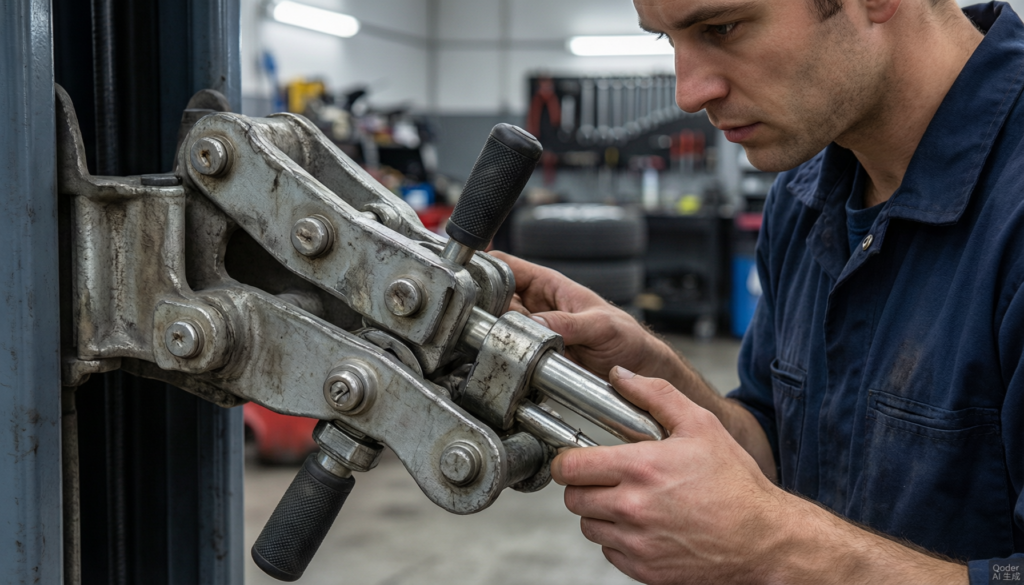
Mechanical locks physically prevent the lift from lowering, independent of hydraulic pressure. They are the primary safeguard against unintended descent.
Most car lifts use one of two locking systems: manual locks that engage at fixed positions (typically every few inches of lift height) or automatic locks that engage as the lift rises. Manual locks require the operator to physically set them before working under the vehicle. Automatic locks engage without operator intervention but must be released before lowering.
The locking mechanism itself, whether it is a pawl-and-ratchet system, a hydraulic lock, or a mechanical bar, must be rated for the lift’s full capacity. A lock that works on an empty platform may fail under a loaded vehicle. Ask the supplier for the lock’s rated capacity and whether it has been tested under load.
Locking positions matter as well. If the lift only locks at full extension, you cannot safely work at intermediate heights. Look for lifts that lock at multiple positions throughout the range, or that allow the operator to set locks at the exact working height needed. Our vehicle lift types guide covers how different lift designs handle mechanical locking.
Hydraulic Protection Against Pressure Loss
Hydraulic systems can fail in multiple ways. Each failure mode requires a specific protective mechanism—verify that the model you are ordering includes the right protection for your risk profile.
| Failure Mode | Protection Mechanism | What to Ask the Supplier |
|---|---|---|
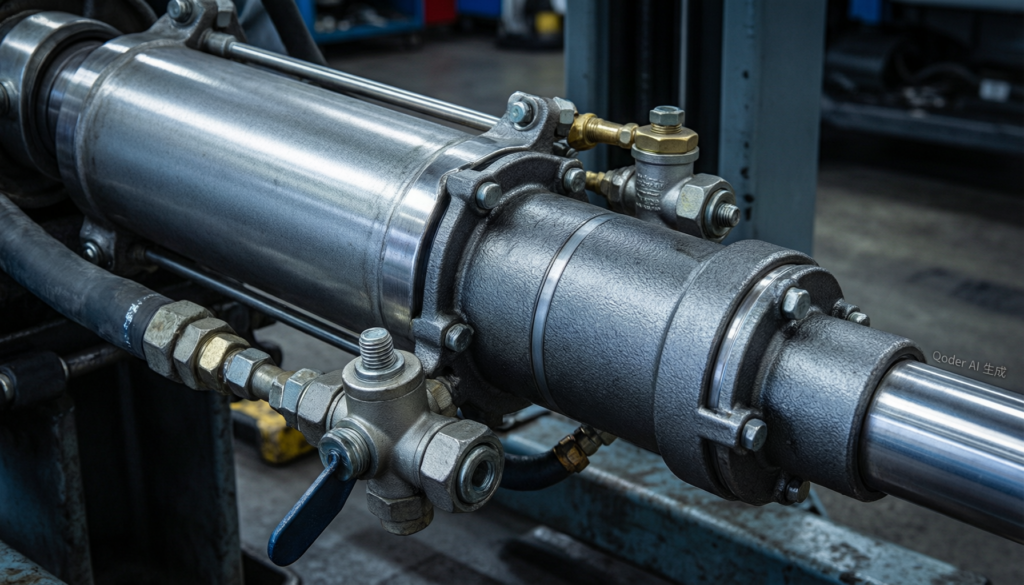
| Pressure loss (pump or seal failure) | Descent control valve or overload valve locks the cylinder when pressure drops below threshold | Does the lift include a pressure-loss valve? Has it been tested under simulated failure? |
| Hose rupture (burst under load) | Rupture valve or flow restrictor slows descent, giving the operator time to react | Are all hydraulic lines protected? What is the maximum flow rate through the restrictor? |
| Seal leakage (slow drift downward) | Mechanical lock or hydraulic hold valve prevents drift even with internal leakage | What is the maximum acceptable drift rate? How often should seals be inspected? |
| Pump malfunction (loss of lift capability) | Emergency lowering: manual release valve or battery-backed pump | Can the lift be lowered safely during complete pump failure? |
على سبيل المثال, the GF-L12E mid-rise scissor lift lists its rated hydraulic pressure (20 MPa) و 5 positive mechanical lock positions as model-specific specifications a buyer can verify against supplier claims.
Synchronization and Uneven Lifting Protection
When a lift has multiple arms or cylinders, they must rise at the same rate. Uneven lifting tilts the vehicle, shifts the load, and can damage the lift structure. Three common synchronization approaches differ in mechanism, cost, and maintenance requirements.
| Method | How It Works | What to Verify |
|---|---|---|
| Mechanical | Linked chains, cables, or shafts force both sides to move together | Does the linkage require regular adjustment? What is the backlash tolerance? |
| Hydraulic | Flow dividers send equal fluid volume to each cylinder regardless of load | Are flow dividers included? Are they adjustable for different arm lengths? |
| Electronic | Position sensors and a control system adjust each actuator independently in real time | What is the sensor accuracy? What happens if one sensor fails mid-lift? |
Synchronization errors are especially dangerous when lifting vehicles with high centers of gravity, such as SUVs or loaded vans. Our comparison of two-post and four-post lifts covers how each design handles load balance.
Limit Controls and Emergency Functions
Beyond hydraulic and mechanical safeguards, the lift must prevent over-travel and give the operator a manual override when automated systems fail.
| Function | Purpose | Verification Point |
|---|---|---|
| Upper limit switch | Stops the lift at maximum height to prevent cylinder over-extension | Is the height adjustable for different vehicles? |
| Lower limit switch | Stops the platform at minimum height to prevent structural contact | Does the switch activate before the platform reaches full collapse? |
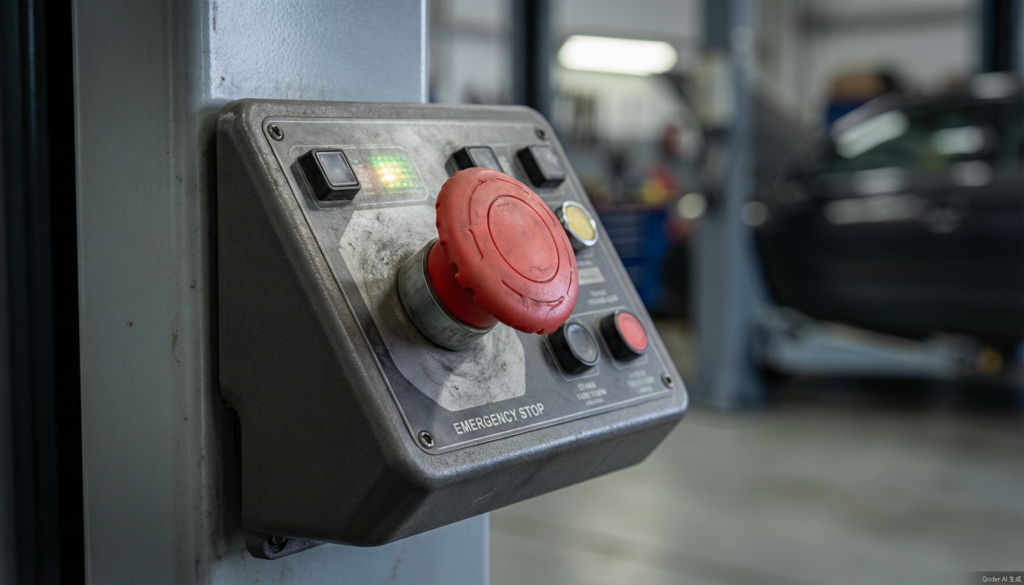
| Emergency stop button | Hardwired power cutoff halts all lift movement immediately | Is it independent of the control software? Accessible from ground level? |
| Emergency lowering | Manual pump release, battery-backed system, or mechanical valve to lower under power failure | Has it been tested under full vehicle weight? How many lowering cycles per charge? |
How Safety Functions Should Be Tested
A safety feature is only as reliable as its test evidence. Request documentation showing that each function was tested under realistic conditions, not just during factory acceptance.
Factory load tests typically verify that the lift can support its rated capacity. But they may not test the emergency stop under full load, the synchronization under uneven weight distribution, or the hydraulic protection under simulated hose failure. Ask the supplier for test reports that cover each safety function separately.
On-site testing after installation is equally important. The lift should be tested with representative vehicles from your workshop, not just a generic test weight. Verify that the locks engage at your working heights, that the emergency lowering function works with your heaviest vehicle, and that synchronization holds under your typical load distribution.
Document these tests and keep the records. If a safety incident occurs, you will need evidence that the lift was tested and maintained according to the manufacturer’s specifications. Some regions require annual safety inspections by certified technicians; check your local regulations. The evaluation sequence for a manufacturer’s test documentation is covered in our guide on كيفية تقييم الشركة المصنعة لرفع السيارة.
Documents and Evidence to Request
Before approving a purchase, request the documentation that proves each safety function is included, tested, and maintained.
| Document | What to Verify |
|---|---|
| Model-specific safety specification | Lists all safety features included in the ordered model: locks, hydraulic protection, synchronization, emergency functions |
| Factory test reports | Documents load tests, emergency stop tests, synchronization tests, and hydraulic protection tests for the specific serial number |
| Conformity documents | CE marking, test reports, and declarations required by your destination market, specific to the exact model and electrical configuration |
| Operator and service manuals | Include safety function descriptions, test procedures, maintenance schedules, and troubleshooting guides |
| Inspection records | If the lift has been previously installed or demoed, request records of all safety tests performed |
| Warranty and service terms | Specify which safety components are covered, what maintenance is required to keep the warranty valid, and how claims are handled |
If the supplier cannot provide these documents for the specific model and serial number you are ordering, consider that a red flag. Generic certificates that do not identify the exact configuration may not apply to your lift.
الأسئلة المتداولة
What safety features should a car lift have?
A car lift should include mechanical locks to prevent unintended lowering, hydraulic protection against pressure loss or hose failure, synchronization controls to keep arms level, limit switches to prevent over-extension, emergency stop and lowering functions, and model-specific test documentation proving each function works under load.
How do car lift safety locks work?
Mechanical locks physically engage with the lift structure to prevent downward movement. Manual locks require the operator to set them at fixed positions; automatic locks engage as the lift rises. Both types must be rated for the lift’s full capacity and tested under load to ensure they hold if hydraulic pressure is lost.
What happens if hydraulic pressure is lost?
If the lift includes pressure-loss protection valves, these lock the cylinders in place when pressure drops below a safe threshold. If the lift relies solely on mechanical locks, the operator must ensure locks are engaged before working under the vehicle. Without either protection, a hydraulic failure can cause the lift to drop unexpectedly.
Can a lift be lowered during a power failure?
Lifts with emergency lowering functions can be lowered manually during a power failure. This may be a manual pump release, a battery-backed system, or a mechanical release valve. Test this function during installation to ensure it works under your typical load conditions.
What safety evidence should a supplier provide?
Request model-specific safety specifications, factory test reports for each safety function (load tests, emergency stop, synchronization, hydraulic protection), conformity documents for your destination market, operator and service manuals, inspection records, and warranty terms covering safety components. Generic certificates that do not identify the exact configuration are not sufficient.
الأفكار النهائية
Safety is a model-specific configuration, not a generic certificate. Verify each function on the exact lift you are ordering, request the test evidence behind it, and compare answers across suppliers before committing.


