
The terms “OEM” and “private label” are used inconsistently in the auto service equipment industry. Some suppliers use them interchangeably; others draw sharp distinctions. For buyers developing branded product lines, the cooperation model affects customization scope, engineering responsibility, approval processes, documentation requirements, and quality control.
This guide compares OEM and private label cooperation routes across model selection, branding, configuration changes, sample approval, order requirements, and repeat-order management. The goal is to help you define the actual responsibilities in your quotation and contract rather than relying on cooperation labels that may mean different things to different suppliers.
What Do OEM and Private Label Mean in This Industry?
In the auto service equipment industry, “OEM” (Original Equipment Manufacturer) and “private label” refer to cooperation models where the supplier manufactures equipment that is sold under the buyer’s brand name. Sin embargo, the exact division of responsibilities varies by supplier.
| Cooperation Model | Buyer’s Role | Supplier’s Role | Typical Scope |
|---|---|---|---|
| OEM | Specifies custom design, engineering, and configuration; may provide drawings or performance targets | Manufactures to buyer specifications; may or may not have a matching existing platform | More engineering work, multiple samples, longer development timeline |
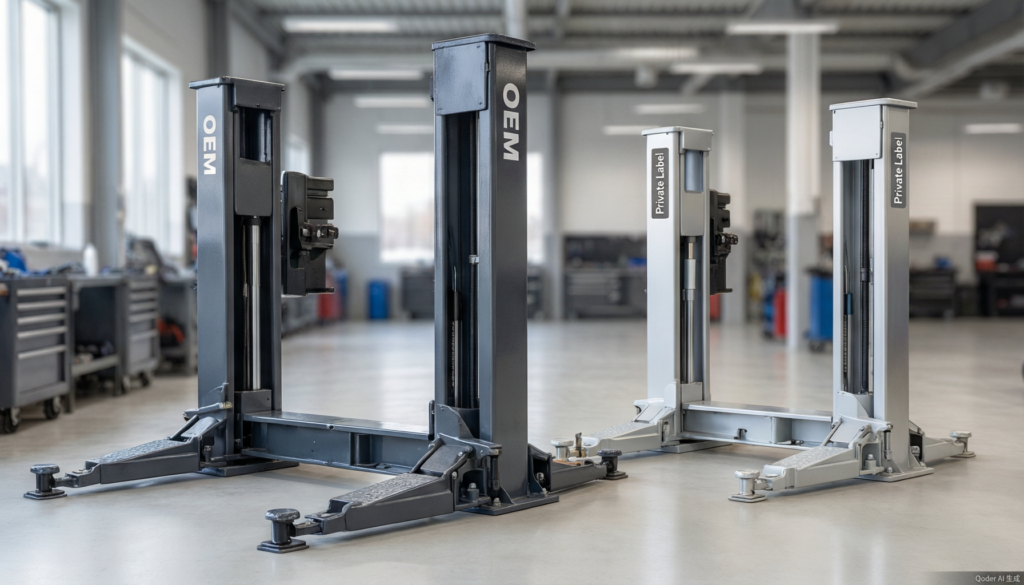
| Private label | Selects an existing product from the supplier’s catalog; applies own branding (nameplates, labels, packaging, docs) | Retains design and engineering responsibility; applies buyer’s branding elements | Less engineering, fewer samples, shorter lead time |
These definitions are not universal. Some suppliers use “OEM” for any branded order; others call full custom development “private label.” Verify the actual scope of work, engineering responsibility, and approval processes in the quotation and contract rather than relying on the cooperation label.
Start with an Existing Model or Submit Custom Requirements?
The first decision in OEM or private label cooperation is whether to start with an existing product platform or submit fully custom requirements.
| Approach | What It Means | Development Impact | Typical For |
|---|---|---|---|
| Existing model selection | Choose a product the supplier already designs; request minor modifications (branding, color, voltage, plug) | Lower risk, fewer samples, shorter lead time | Private label cooperation |
| Full custom requirements | Provide drawings, specs, or performance targets for a product that does not exist in the catalog | More engineering cycles, multiple sample rounds, longer timeline | OEM cooperation with specific market needs |
| Platform modification (middle ground) | Modify an existing platform: different motor size, lifting capacity, or control system | Moderate development time; more customization than branding-only but less than full custom | Buyers needing differentiation without full re-engineering |
To understand how supplier roles differ from manufacturer roles in equipment sourcing, read car lift supplier vs. manufacturer and alignment machine supplier vs. manufacturer.
Branding, Color, Labels, Packaging, and Documentation
Branding customization is the most common element of private label cooperation. It includes nameplates, labels, packaging, color, and documentation.
Nameplates and labels are the most visible branding elements. They include the buyer’s company name, logo, product model number, and compliance markings (CE, UL, etc.). Nameplates are typically made of metal or durable plastic and are attached to the equipment. Labels may be adhesive stickers applied to the packaging or documentation. Verify that the supplier can produce nameplates and labels to your design specifications and that they are included in the quotation.
Color customization may include the equipment’s paint color, powder coating color, or plastic component color. Some suppliers offer a range of standard colors; others require custom color matching. Custom colors may require minimum order quantities (MOQ) or additional lead time. Verify the color options and any associated costs or MOQ requirements.
Packaging includes the carton, foam inserts, plastic bags, and any protective materials. Buyers may request custom packaging with their logo, product information, and handling instructions. Custom packaging may require MOQ or additional lead time. Verify that the packaging design meets your requirements and that it is included in the quotation.
Documentation includes user manuals, installation guides, warranty cards, and compliance certificates. Buyers may request that documentation be translated into their target market’s language, include their branding, or follow their formatting standards. Custom documentation may require translation services, graphic design work, or approval from the supplier’s technical team. Verify the documentation requirements and any associated costs.
Electrical and Market-Specific Configuration Changes
Electrical configuration changes are common for equipment sold in different markets. These changes may include voltage, frequency, plug type, and safety certifications.
| Configuration | Common Options | What to Verify |
|---|---|---|
| Voltage and frequency | 110V/60Hz (NA), 220V/50Hz (EU/Asia), 230V/50Hz (AU), 380V/50Hz (industrial) | Motor, control system, and components configured for the target market standard |
| Plug type | Type A/B (NA), C/E/F (EU), G (UK), I (AU), L (Italy), or hardwired | Correct plug included in quotation or hardwired spec provided |
| Safety certifications | CE (EU), UL/ETL (NA), SAA (AU), PSE (Japan) | Which certifications are included vs. buyer’s responsibility; additional cost for non-standard certs |
| Language | Control panel UI, user manual, safety warnings | Multi-language panel availability; manual translation costs; target market regulatory language requirements |
For evaluation criteria when assessing a manufacturer’s capability, see how to evaluate a tire changer manufacturer and how to evaluate an alignment machine manufacturer.
Samples, Drawings, and Configuration Approval
Samples and drawings are used to verify that the supplier’s product meets the buyer’s requirements before placing a full order.
| Verification Step | Etiqueta privada (Existing Model) | OEM (Custom Requirements) |
|---|---|---|
| Samples | One or two units to verify product meets expectations; cost may be credited against first order | Multiple rounds to verify design, engineering, and performance; typically charged at premium pricing |
| Drawings | Supplier provides existing model drawings for buyer review | Buyer provides custom specs OR supplier proposes design drawings for buyer approval; both must sign off before production |
| Configuration approval | Verify branding, packaging, electrical config, and documentation match the order | Verify full custom configuration: electrical, mechanical, software, branding, and accessories |
| Change control | Post-approval changes may be simple (new label artwork) | Post-approval changes may require additional samples, longer lead time, or re-engineering costs |
How MOQ, Lead Time, and Development Work May Change
OEM and private label cooperation may have different MOQ, lead time, and development work requirements.
MOQ (Minimum Order Quantity) is the minimum number of units the supplier requires for a production order. Private label cooperation (existing model) may have lower MOQ because the supplier already has the product designed and tooled. OEM cooperation (custom requirements) may have higher MOQ because the supplier must invest in design, engineering, and tooling for the custom product. Some suppliers waive MOQ for the first order; others require higher MOQ for custom products. Verify the MOQ for your specific cooperation model.
Lead time is the time from order placement to shipment. Private label cooperation may have shorter lead time (30–60 days) because the product is already designed and tooled. OEM cooperation may have longer lead time (60–120 days or more) because of the additional design, engineering, and sample approval work. Lead time may also be affected by the supplier’s production schedule, component availability, and shipping logistics. Verify the lead time for your specific order.
Development work includes the design, engineering, sampling, and approval activities required before production. Private label cooperation may require minimal development work (branding design, packaging design, documentation translation). OEM cooperation may require significant development work (product design, engineering validation, multiple samples, certification testing). The buyer and supplier must agree on who is responsible for each development activity and who bears the cost.
For broader supplier selection guidance, read how to choose automotive workshop equipment suppliers and browse our equipment product range to see what is available for private label or OEM customization.
Quality Inspection and Change Control for Repeat Orders
Quality inspection and change control are critical for maintaining product consistency across repeat orders.
Quality inspection should be performed before shipment to verify that the products meet the buyer’s requirements. Inspection may include visual inspection (branding, color, finish), dimensional inspection (critical dimensions, tolerances), functional testing (electrical safety, performance), and packaging inspection (labeling, documentation). The buyer may perform the inspection themselves, hire a third-party inspection company, or request the supplier to provide inspection reports. Verify the inspection requirements and who is responsible for the cost.
Change control is the process of managing changes to the product design, configuration, or manufacturing process after the initial approval. For repeat orders, the buyer may request changes (branding updates, configuration changes, component substitutions). The supplier may also propose changes (component discontinuation, process improvements, cost reductions). All changes should be documented, evaluated, and approved before implementation. Uncontrolled changes can lead to product inconsistency, compliance issues, or customer complaints.
Repeat-order management includes the processes for placing repeat orders, tracking production, and managing delivery. The buyer and supplier should agree on order placement procedures, lead times, payment terms, and communication protocols. Repeat orders should reference the original approval documents (drawings, samples, specifications) to ensure consistency. Any changes to the original approval should be documented and approved before the repeat order is produced.
Which Cooperation Route Fits Your Business?
The choice between OEM and private label cooperation depends on your business model, market requirements, technical capabilities, and investment capacity.
| Route | Best For | Investment & Time | Differentiation |
|---|---|---|---|
| Private label | Distributors or retailers adding a product line quickly without custom development | Low upfront cost; short lead time; less technical expertise needed | Limited — competitors may source the same model from the same supplier |
| OEM (full custom) | Brands with specific market requirements that existing products do not meet | Higher investment; longer development; more engineering coordination | High — custom features, performance, or design create unique positioning |
| Mixed / phased | Businesses starting with private label to test the market, then moving to OEM; or OEM for specialized SKUs and private label for standard items | Scales from low to high as the brand matures | Balances speed-to-market with eventual differentiation |
Regardless of the cooperation model, define the actual responsibilities, approval processes, and quality requirements in the quotation and contract. Do not rely on labels alone—verify the specific terms for your order.
Frequently Asked Questions
What is OEM auto service equipment?
OEM (Original Equipment Manufacturer) auto service equipment is manufactured by a supplier according to the buyer’s custom specifications. The buyer may provide design, engineering, or performance requirements, and the supplier manufactures to those requirements. OEM cooperation typically involves more development work, more samples, and longer lead times than private label cooperation.
What is private-label equipment?
Private label equipment is selected from the supplier’s existing product catalog and branded with the buyer’s name, logo, and packaging. The product design and engineering remain the supplier’s responsibility; the buyer customizes only the surface-level branding elements. Private label cooperation typically involves less development work, fewer samples, and shorter lead times than OEM cooperation.
Is private label the same as OEM?
No, private label and OEM are not the same, although the terms are sometimes used inconsistently in the industry. Private label typically means branding an existing product; OEM typically means manufacturing to custom specifications. Sin embargo, some suppliers use these terms differently, so verify the actual scope of work, engineering responsibility, and approval processes in your quotation and contract.
Which equipment details can be customized?
Customizable details include branding (nameplates, labels, logo), color, packaging, documentation, electrical configuration (voltage, frequency, plug), language, and safety certifications. For OEM cooperation, additional customization may include product design, engineering specifications, performance characteristics, and component selection. Verify which details can be customized for your specific cooperation model.
How should repeat-order changes be controlled?
Repeat-order changes should be documented, evaluated, and approved before implementation. All changes (branding updates, configuration changes, component substitutions) should reference the original approval documents (drawings, samples, specifications). The buyer and supplier should agree on a change control process that includes written approval, updated samples (if necessary), and updated documentation. Uncontrolled changes can lead to product inconsistency or compliance issues.


