
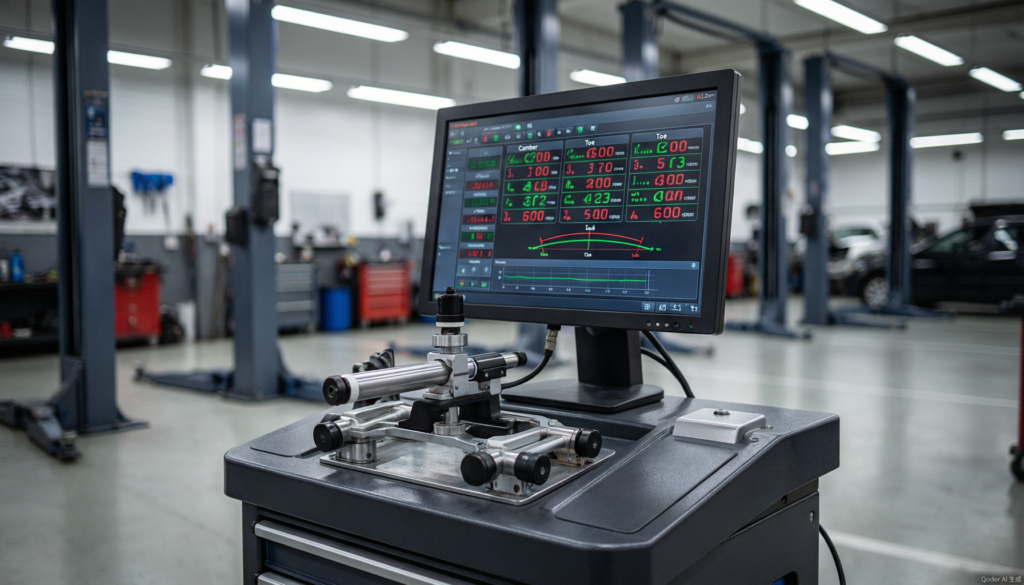
Wheel alignment machine specifications vary significantly between models and manufacturers. A specification sheet is useful only when each value is tied to the complete quoted system and defined test conditions. Buyers must distinguish between range, résolution, précision, and repeatability—and confirm which accessories and software services are included in the quotation.
This guide walks through the key specifications to compare, explains what each term means in practice, and identifies the information that must appear in the final quotation. The goal is to help you evaluate alignment machines on equal terms and reduce the risk of missing accessories, software misunderstandings, or installation incompatibility.
Start with Vehicle Coverage and Workshop Application
Avant de comparer les spécifications, define the vehicle range and services your workshop handles. This determines the minimum performance requirements for the alignment machine.
| Planning Step | What to Define | Why It Matters |
|---|---|---|
| Vehicle coverage | Wheelbase range (typically 2,400–3,000 mm for cars; more for SUVs/trucks) and track-width range (1,400–1,700 mm for cars) | Determines minimum bay dimensions and clamp/target arm length |
| Workshop application | Standard two-wheel, four-wheel, thrust-angle, setback, or Ackermann correction work | Defines required software features and measurement capability |
| Database coverage | Makes, models, and years the machine must include; check historical model support if you service older vehicles | A machine with correct specs but wrong database coverage is useless for your market |
Measurement Range, Précision, Resolution, and Repeatability
These four terms describe the machine’s measurement capability, but they are not interchangeable. Each has a distinct meaning that affects how you interpret the specification sheet.
| Term | Definition | Typical Example | What It Affects |
|---|---|---|---|
| Measurement range | Span of values the machine can measure | Courbure ±10°, toe ±2° | Must cover the adjustment range of your target vehicles |
| Resolution | Smallest increment the machine displays | 0.01° ou 0.1 mm | High resolution alone does not guarantee accuracy |
| Précision | How close the measured value is to the true value | ±0.03° under defined test conditions | Most critical spec; verify it applies to the complete system, not just components |
| Repeatability | Consistency when measuring the same wheel multiple times | ±0.02° | Indicates sensor stability and mechanical integrity; often more important than absolute accuracy |
Camera, Target, Sensor-Head, and Data-Transmission Configuration
Modern alignment machines use cameras and targets (or sensor heads) to measure wheel angles. The configuration affects measurement speed, précision, and ease of use.
Camera-based systems use one or more cameras to read reflective targets attached to the wheels. The number of cameras (typiquement 2 ou 4) and their resolution affect measurement speed and accuracy. Four-camera systems can measure all four wheels simultaneously; two-camera systems may require repositioning. Camera resolution (measured in megapixels) affects the system’s ability to detect small angle changes.
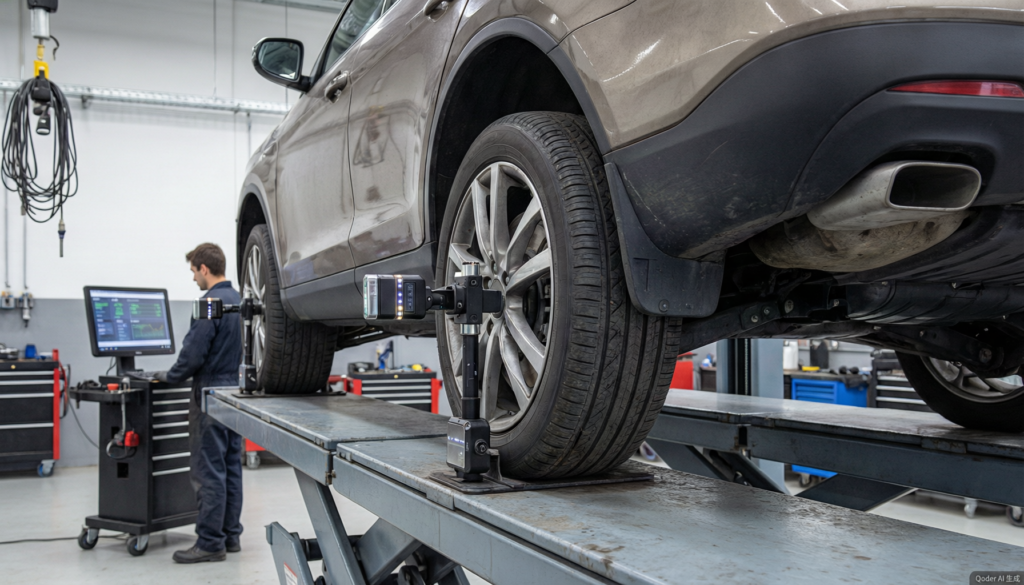
Cibles (or reflectors) are attached to the wheels and read by the cameras. Some systems use passive reflective targets; others use active sensor heads with embedded electronics. Active sensor heads can transmit data wirelessly, eliminating cables between the wheel units and the main computer. Wireless systems are faster to set up but require battery management.
Sensor heads (in some systems) combine the target and the measurement electronics in a single unit attached to the wheel. These heads measure the wheel’s angle directly and transmit the data to the main computer. Sensor-head systems may offer higher accuracy than camera-based systems but can be more expensive to replace if damaged.
Data transmission method (wired or wireless) affects setup time and workshop layout. Wireless systems reduce cable clutter and make it easier to move around the vehicle, but they require battery charging and may have limited range. Wired systems are more reliable but can be cumbersome.
Wheel Clamps, Turntables, Locks, and Included Accessories
Accessories are essential for alignment work, but they are not always included in the base quotation. Verify which accessories are included and which must be purchased separately.
| Accessory | Function | What to Verify |
|---|---|---|
| Wheel clamps | Attach targets or sensor heads to the wheels | Rim size and profile coverage (steel, alloy); whether extra clamp sets are included or optional |
| Turntables / slip plates | Allow front wheels to rotate during alignment procedures | Must match lift type (ciseaux, two-post, four-post) and vehicle weight capacity |
| Steering wheel locks | Hold steering centered during measurement | Included in base quotation or must be purchased separately |
| Brake pedal depressors | Apply consistent brake pressure to eliminate free-play | Often omitted from base quotation; confirm before ordering |
| Calibration tools | Reference devices for periodic verification | Whether provided with the machine or sold as a separate kit |
Base de données des véhicules, Software Language, and Update Terms
The vehicle database contains alignment specifications for different makes, models, and years. Software language and update terms affect how you use the machine and maintain its accuracy over time.
| Software Aspect | What to Check | Why It Matters |
|---|---|---|
| Database coverage | Makes, models, and years included; historical models if you service older vehicles | Incomplete coverage means technicians must look up specs externally |
| Language options | Available languages for your technicians (Anglais, Spanish, Chinois, etc.) | Mismatched language slows workflow and increases input errors |
| Update terms | Free period (1 year, 3 années, lifetime) or annual fee; how updates are delivered | Recurring update costs affect total cost of ownership over the machine’s lifespan |
| Advanced features | Corner-weight measurement, Ackermann correction, thrust-angle, integration with workshop management systems | Not all features are standard; identify what you need and confirm inclusion in the quoted model |
Lift Compatibility, Installation Space, Power, and Computer Requirements
The alignment machine must be compatible with your workshop’s lift, floor space, electrical supply, and computer infrastructure. Verify these requirements before ordering.
Lift compatibility affects how the alignment machine is installed. Some systems are designed for scissor lifts; others for two-post or four-post lifts. The machine’s cameras or sensor heads must be positioned at the correct height and distance from the wheels. Verify that the quoted system is compatible with your lift type and that any required lift modifications (turntable installation, jack stands) are included or available.
Installation space requirements include the footprint of the alignment machine, the clearance needed for the cameras or sensor heads, and the space required for the operator to move around the vehicle. Some systems require dedicated alignment bays; others can be installed in general service bays. Verify that your workshop has adequate space for the quoted system.
Power requirements (voltage, frequency, phase) must match your workshop’s electrical supply. Most alignment machines run on single-phase 220V power, but some models may require three-phase power or special circuits. Verify the power requirements before ordering.
Computer requirements include the operating system, processor speed, RAM, and display resolution. Some alignment machines include a dedicated computer; others require you to provide your own. If you must provide the computer, verify the specifications and ensure that your IT infrastructure can support them.
Calibration, Verification, and Acceptance Evidence
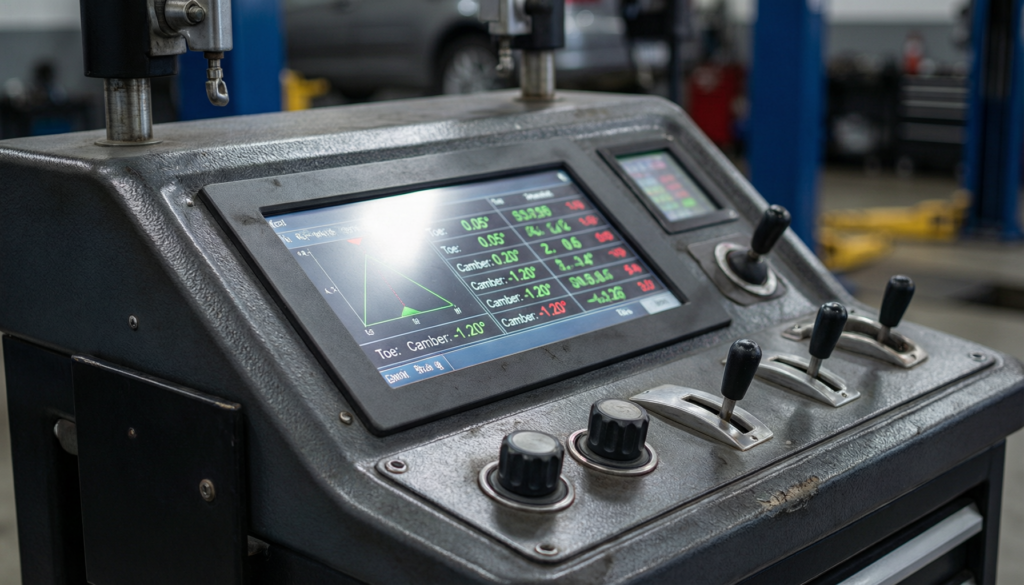
Calibration ensures that the alignment machine measures accurately. Verification confirms that the machine meets the manufacturer’s specifications. Acceptance evidence documents that the machine was installed correctly and is ready for use.
Calibration procedures vary by manufacturer. Some machines require periodic calibration (e.g., annually, every two years); others are factory-calibrated and do not require recalibration unless damaged. Verify the calibration requirements and the cost of calibration tools or services. Some manufacturers offer remote calibration support; others require on-site service.
Verification is the process of checking that the machine measures accurately after installation. This typically involves measuring a known reference wheel or using calibration targets. The manufacturer should provide verification procedures and acceptance criteria. Verify that the machine passes verification before accepting delivery.
Acceptance evidence includes documentation that the machine was installed correctly, calibrated (if required), and verified. This may include installation reports, calibration certificates, verification results, and training records. Request this documentation before making final payment.
Calibration intervals are model-specific and depend on the machine’s design, usage, and environment. Do not assume that all alignment machines have the same calibration requirements. Verify the interval for the specific model you are ordering.
Specifications That Must Appear in the Final Quotation
The final quotation should include all specifications, accessories, software services, and installation requirements. Missing information can lead to misunderstandings, additional costs, or installation delays.
| Specification | What Must Appear in the Quotation |
|---|---|
| Vehicle coverage | Wheelbase and track-width range; vehicle types covered (passenger cars, VUS, camions légers, heavy-duty). |
| Performances de mesure | Range, précision, résolution, and repeatability for camber, roulette, toe, and other measured angles. |
| Camera and sensor configuration | Number of cameras, résolution, target type (passive/active), data transmission method (wired/wireless). |
| Included accessories | Wheel clamps, turntables, steering locks, brake depressors, calibration tools, carrying cases. |
| Vehicle database | Coverage (makes, models, années); update terms (free/paid, duration); language options. |
| Installation requirements | Lift compatibility, floor space, besoins en énergie, computer specifications. |
| Calibration and verification | Calibration interval, procedure, cost; verification method; acceptance evidence provided. |
| Warranty and support | Warranty duration, coverage, response time; technical support availability; spare parts availability. |
When you receive the quotation, compare it against this checklist. If any specification is missing or unclear, request clarification before placing the order. This reduces the risk of receiving a machine that does not meet your requirements or requires additional purchases to become operational.
If you’re also evaluating alignment machine types (3D imaging, CCD, laser), notre guide pour choosing an alignment machine supplier covers the differences between technologies and supply chain models. The specification comparison process applies across all types—but the camera and sensor configurations vary significantly by technology.
Foire aux questions
Which wheel alignment specifications matter?
The most important specifications are measurement accuracy (how close to the true value), répétabilité (consistency of repeated measurements), vehicle coverage (wheelbase and track-width range), camera/sensor configuration, and included accessories. Also verify the vehicle database coverage, software language, update terms, and installation requirements.
What is the difference between accuracy and resolution?
Accuracy is how close the measured value is to the true value (e.g., ±0.03°). Resolution is the smallest increment the display can show (e.g., 0.01°). High resolution does not mean high accuracy—a machine can display small increments but still be inaccurate if the sensors are poorly calibrated.
Are clamps and turntables included?
Not always. Wheel clamps, turntables, steering locks, and brake depressors are essential accessories but may not be included in the base quotation. Verify which accessories are included and which must be purchased separately. Missing accessories can prevent the machine from being operational.
Does the database require updates?
Oui, vehicle databases require updates to add new vehicle models and correct specification errors. Some manufacturers include free updates for a specified period (one year, three years, lifetime); others charge annual fees. Verify the update terms and cost before ordering.
What must appear in the final quotation?
The quotation must include vehicle coverage, measurement performance (précision, résolution, répétabilité), camera/sensor configuration, included accessories, database coverage and update terms, exigences d'installation, calibration procedures, and warranty/support terms. Missing information can lead to additional costs or installation delays.


