
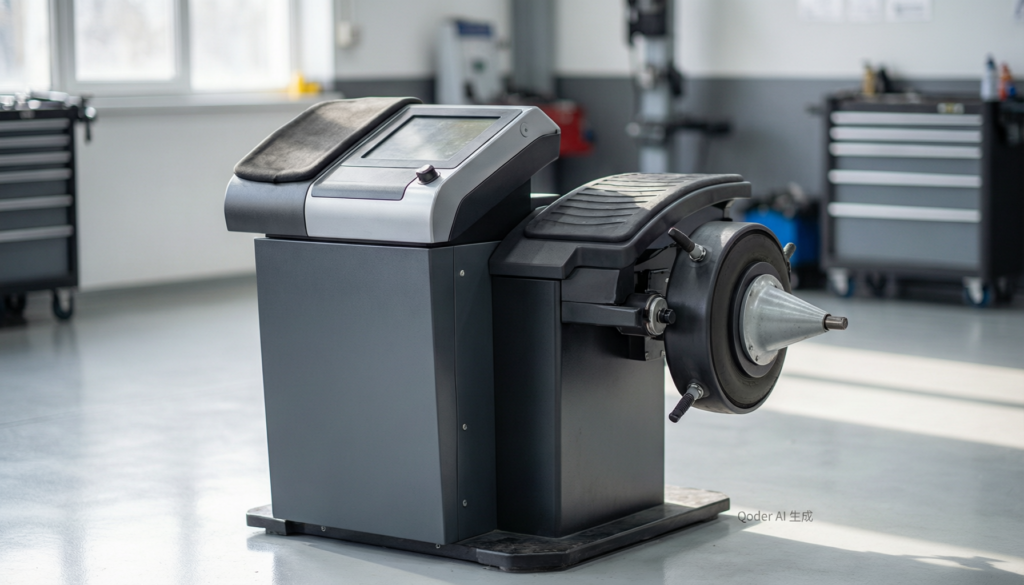
Passenger-car and heavy-duty wheel balancers serve different vehicle ranges, and the differences extend far beyond weight capacity. Larger wheels change how they are mounted, handled, and balanced—affecting everything from adapter requirements to floor space, electrical supply, and operator workflow.
This guide compares the two balancer categories across wheel capacity, machine structure, accessories, operating modes, and spare parts requirements. The goal is to help workshops select the correct balancer type and help distributors build clearer product ranges that match their target customers.
Define Passenger-Car and Heavy-Duty Balancing Applications
Passenger-car and heavy-duty balancers are defined by the vehicles they serve, not just their weight ratings. Understanding the target applications helps you select the correct machine category.
| Application | Vehicles Served | Typical Wheel Weight | Rim Diameter | Rim Width | Where Found |
|---|---|---|---|---|---|
| Passenger-car | Sedans, hatchbacks, SUVs, light vans, pickups | 8–25 kg | 13”–22” | 5”–10” | General repair shops, tire dealerships, service centers |
| Heavy-duty | Trucks, buses, construction equipment, agricultural machinery | 40–100+ kg | 15”–24.5” (truck) or larger | 6”–12”+ (wider for off-road) | Fleet workshops, truck service centers, heavy equipment repair |
The boundary between the two categories is not always sharp. Some workshops serve both passenger cars and light trucks, requiring a balancer that covers the overlap. But the extreme ends of the range—small passenger-car wheels and large truck or off-road wheels—require distinctly different machines.
Compare Wheel Weight, Diameter, and Rim-Width Capacity
Wheel weight, diameter, and rim width are the primary capacity specifications that separate passenger-car from heavy-duty balancers.
| Specification | Passenger-Car | Heavy-Duty | What to Verify |
|---|---|---|---|
| Max wheel weight | 25–40 kg | 60–100 kg or more | Spindle, shaft, and bearing system must support the rated weight without deflection |
| Rim diameter range | 10”–24” | 12”–30” or more | Turntable, guard, and measuring arm must reach the largest diameter you handle |
| Rim width range | Up to 10”–12” | Up to 15”–20” or more | Clamping system, cone range, and spacer options must cover your widest rims |
All performance figures must be taken from the selected model’s specification sheet. Do not assume that a machine labeled “heavy-duty” automatically covers your target wheel range—verify the exact weight, diameter, and width limits.
Shafts, Cones, Spacers, and Heavy-Wheel Adapters
Heavy wheels require different mounting hardware than passenger-car wheels. The shaft, cones, spacers, and adapters must handle larger center holes, wider rims, and heavier loads.
The spindle shaft diameter must support the wheel’s weight without bending. Passenger-car balancers typically use shafts of 20–30 mm diameter. Heavy-duty balancers use shafts of 30–50 mm or more. The shaft length must also accommodate wider rims and multiple spacers.
Cones (or centering cones) fit into the wheel’s center hole to position it on the shaft. Passenger-car wheels have center holes of 50–70 mm typically. Heavy-duty truck wheels have center holes of 150–220 mm or more. The balancer must include cones in this larger range, or the cones must be available as optional accessories.
Spacers are used to position the wheel at the correct distance from the machine’s measurement sensors. Heavy wheels may require longer or thicker spacers to accommodate wider rims or dual-wheel configurations. Some heavy-duty balancers include extended spacer sets; others require them as optional purchases.
Truck-wheel adapters (sometimes called truck adapters or heavy-duty adapters) are specialized mounting plates that allow the balancer to handle wheels with non-standard center hole sizes or mounting patterns. These adapters are essential for certain truck and bus wheel types. Verify whether the quoted balancer includes these adapters or whether they must be purchased separately.
Wheel Loading and When a Pneumatic Lifter Is Needed
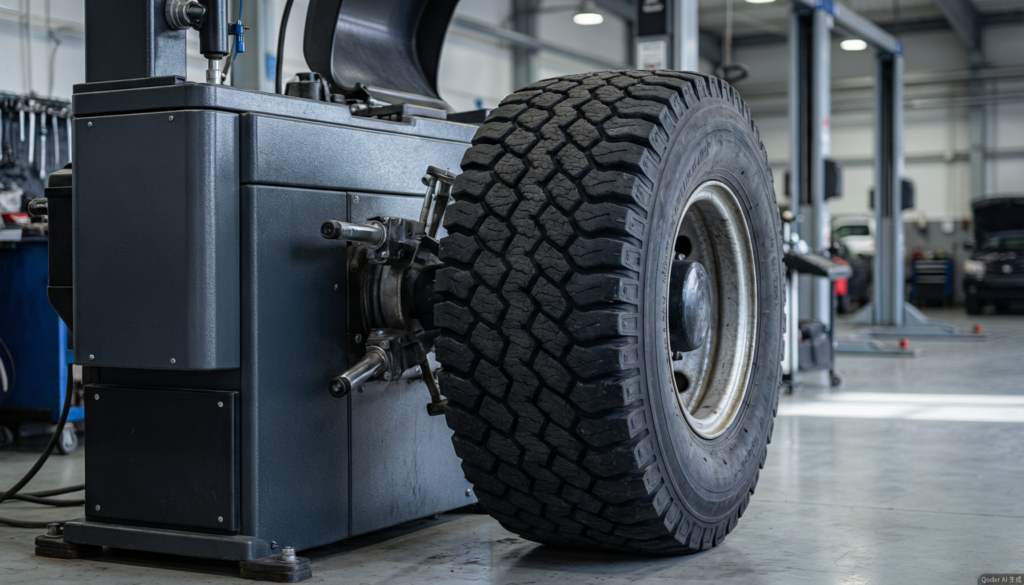
Heavy wheels (40 kg and above) are difficult to lift manually onto the balancer shaft. A pneumatic wheel lifter reduces operator strain and improves safety.
Passenger-car wheels (8–25 kg) can be lifted onto the balancer shaft by hand without significant difficulty. Most technicians can handle this repeatedly throughout the day without excessive fatigue.
Heavy-duty wheels (40–100 kg) require significant effort to lift, especially when positioning the wheel’s center hole onto the shaft. Repeated manual lifting can cause operator fatigue, back strain, or injury over time. Many heavy-duty workshops use pneumatic wheel lifters (also called wheel loaders or lift tables) to raise the wheel to the correct height.
A pneumatic lifter is not always included with the balancer. Some manufacturers offer it as an optional accessory. If your workshop handles heavy wheels regularly, verify whether the quoted balancer includes a lifter or whether one must be purchased separately. The lifter’s capacity must match the heaviest wheels you handle.
Machine Structure, Floor Space, and Electrical Requirements
Heavy-duty balancers are larger, heavier, and require more floor space and electrical capacity than passenger-car models.
| Aspect | Passenger-Car Balancer | Heavy-Duty Balancer |
|---|---|---|
| Machine weight | 100–200 kg | 300–600+ kg with reinforced frame |
| Floor space (footprint) | ~0.5–1.0 m² | ~1.5–2.5 m² (more with pneumatic lifter) |
| Electrical supply | Single-phase 220V | Three-phase 380V (for larger motors or pneumatic systems) |
| Motor power | 0.5–1.5 kW | 1.5–3.0 kW or more |
Balancing Modes, Measurement Cycle, and Operator Workflow
Both passenger-car and heavy-duty balancers offer static and dynamic balancing modes, but the measurement cycle time and operator workflow may differ.
Static balancing (single-plane) is used for narrow wheels or wheels that only require correction in one plane. Dynamic balancing (dual-plane) is used for wider wheels that require correction on both the inner and outer flanges. Both balancer categories offer these modes, but the cycle time may differ.
Heavy-duty balancers may have longer measurement cycles because they must rotate heavier wheels and acquire more data points. The machine’s sensor system must handle the increased mass and vibration. Some heavy-duty balancers offer faster cycle times through advanced sensor technology or optimized measurement algorithms.
Operator workflow also differs. Heavy-duty wheels require more handling effort, more adapter changes, and more careful positioning. The operator may need to use a pneumatic lifter, change cones or spacers, and verify the wheel’s position before starting the cycle. These additional steps add time to the overall balancing process, even if the measurement cycle itself is similar.
Spare Parts and Accessories for Different Customer Groups
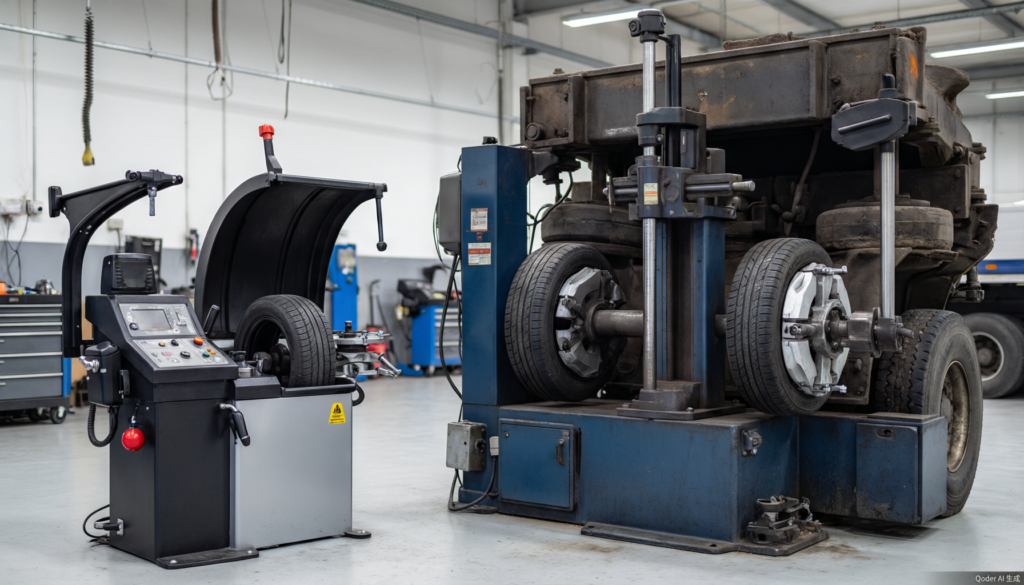
Passenger-car and heavy-duty balancers have different wear parts and accessory requirements. Distributors should stock the appropriate spare parts for their target customer groups.
| Spare Part Category | Passenger-Car Balancers | Heavy-Duty Balancers |
|---|---|---|
| Cones & adapters | Standard cone sets (relatively small, inexpensive) | Larger cones, truck-wheel adapters (heavier, more expensive) |
| Clamping system | Clamping jaws, protective inserts | Reinforced clamping systems; higher wear from increased forces |
| Spacers & shafts | Standard spacers | Heavy-duty spacers rated for higher loads |
| Pneumatic lifter parts | N/A (no lifter typically used) | Seals, hoses, valves if a lifter is included |
Distributors serving both markets must maintain two separate spare parts inventories. Stock levels should reflect the wear patterns and replacement frequency specific to each customer group.
How Distributors Should Separate the Two Product Ranges
Distributors should clearly separate passenger-car and heavy-duty balancer ranges to avoid customer confusion and ensure that buyers select the correct machine for their application.
Product catalogs should list passenger-car and heavy-duty balancers in separate sections, with clear capacity specifications for each model. The catalog should indicate the maximum wheel weight, rim diameter range, rim width range, and whether the model includes truck-wheel adapters or requires them as optional accessories.
Technical documentation should also separate the two ranges. Installation manuals, operating guides, and spare parts lists should be specific to each balancer category. Mixing the documentation can lead to incorrect installation, improper operation, or ordering the wrong spare parts.
Sales support should be trained to ask about the customer’s target vehicle range before recommending a balancer. A customer who services only passenger cars does not need a heavy-duty balancer. A customer who services trucks and buses does not need a passenger-car balancer. Some customers serve both markets and may need two separate machines or a balancer that covers the overlap range.
If you’re also evaluating balancer measurement technology (how the machine detects imbalance), our guide to how wheel balancers measure imbalance explains the sensor principles that apply across both passenger-car and heavy-duty categories. The measurement technology is similar, but the capacity and accessories differ significantly.
Frequently Asked Questions
Can a passenger-car balancer handle truck wheels?
A passenger-car balancer cannot handle most truck wheels. Truck wheels are heavier (40–100 kg vs. 8–25 kg), have larger center holes (150–220 mm vs. 50–70 mm), and may require different adapters. Attempting to balance truck wheels on a passenger-car balancer can damage the machine or produce inaccurate results.
What makes a wheel balancer heavy-duty?
A heavy-duty balancer has higher wheel weight capacity (40–100 kg), larger rim diameter range (up to 30” or more), wider rim width capacity (up to 20” or more), larger shaft and cones for truck wheels, reinforced structure to handle heavier loads, and often a more powerful motor. It may also include or support a pneumatic wheel lifter.
When is a wheel lifter required?
A pneumatic wheel lifter is recommended when handling wheels heavier than 40 kg repeatedly. It reduces operator strain, improves safety, and speeds up the loading process. For passenger-car wheels (8–25 kg), manual loading is typically sufficient. For heavy-duty truck wheels (40–100 kg), a lifter significantly improves workflow efficiency.
Which adapters are needed for truck wheels?
Truck wheels typically require larger centering cones (150–220 mm), truck-wheel adapters (for non-standard center holes or mounting patterns), extended spacers (for wider rims), and possibly a pneumatic wheel lifter. Verify which adapters are included with the balancer and which must be purchased separately.
How should distributors separate the two ranges?
Distributors should list passenger-car and heavy-duty balancers in separate catalog sections, with clear capacity specifications for each. Technical documentation, spare parts lists, and sales support should also be separated by category. This prevents customer confusion and ensures that buyers select the correct machine for their target vehicle range.


