
A wrong vehicle lift choice shows up quickly in daily operations—blocked bays, slower repairs, and avoidable safety risks. Many shops only realize the limits after installation, when space and workflow no longer match the equipment. This guide walks through the main types of vehicle lifts and the practical factors that matter most, including capacity, ceiling height, and concrete requirements, so you can choose with clarity.
The Main Types of Vehicle Lifts
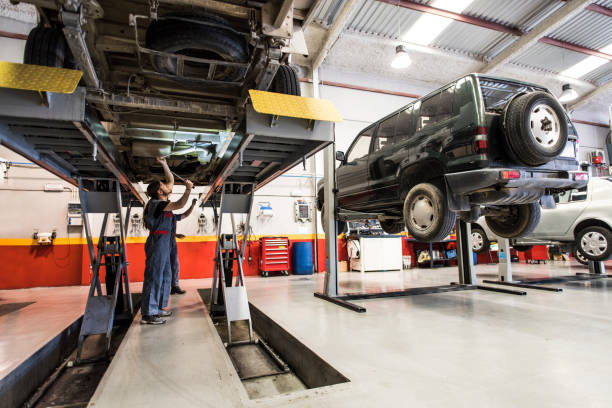
| Lift Type | Primary Application | Space Requirement |
|---|---|---|
| Two-Post | General repair, suspension, underbody | Compact |
| Multi-Post / Runway | Alignment, quick-lube, vehicle storage | Large |
| Scissor | Tire/brake service, low-ceiling bays | Highly Compact |
| Mobile Column | Heavy transit, commercial fleets, buses | Flexible / Storable |
| In-Ground | Dealerships, high-throughput centers | Zero (when retracted) |
Two-Post Frame-Engaging Lifts
Two-post lifts dominate general automotive repair shops. They lift the vehicle by the chassis, freeing up the wheels and providing massive vertical access for technicians targeting complex undercar components.
- Mounting Mechanism: Surface-mounted design using symmetrical or asymmetrical arms to engage the vehicle chassis.
- Service Capability: Provides unobstructed underbody access since the wheels hang free, suiting suspension, exhaust, and transmission repairs.
- Shop Integration: Delivers a compact footprint and high cost-effectiveness for general repair shops.
This design remains the baseline choice for facilities requiring aggressive mechanical access without consuming excess real estate.
Multi-Post and Runway Lifts
Shops focused on high-volume services require equipment that prioritizes speed and drive-on simplicity. Multi-post units carry the weight directly on the tires, creating exceptional balance for longer or heavier vehicles.
- Drive-On Design: Features a drive-on configuration where the vehicle is supported evenly by its tires, ensuring high operational stability.
- Primary Uses: Widely applied in quick-service bays, alignment shops, and multi-level vehicle storage applications.
- High-Throughput Alternatives: Parallelogram variants offer similar drive-on utility but use an arc-motion lifting mechanism to achieve faster cycle times in high-throughput facilities.
Operators rely on this configuration to minimize setup time and safely handle heavy front or rear payloads with minimal balance adjustments.
Scissor Lifts
Space constraints dictate equipment choices in smaller urban garages and dedicated service lanes. Scissor lifts solve vertical and horizontal space limitations without sacrificing core lifting capacity.
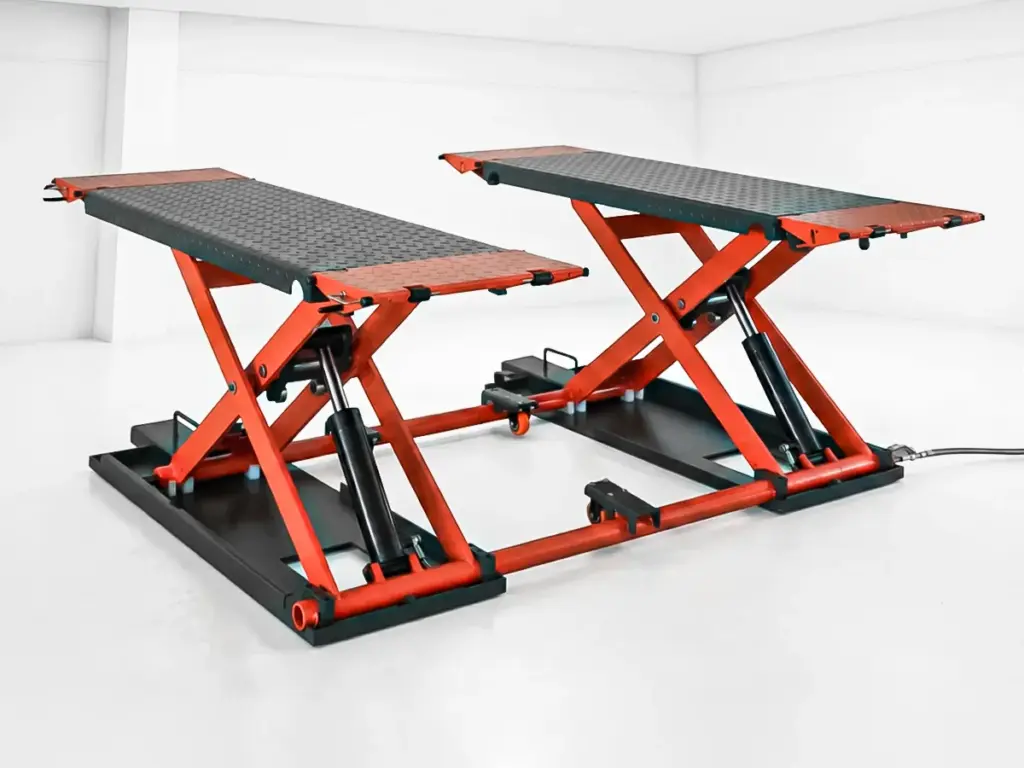
- Vertical Path: Uses an accordion-like X-mechanism to raise vehicles in a straight vertical path, preventing unwanted fore and aft movement.
- Height Options: Available in full-rise, mid-rise, and low-rise models to accommodate environments with restricted ceiling heights.
- Bay Efficiency: Conserves floor space effectively, making it highly practical for dedicated tire, brake, or bodywork bays.
Shops lacking the 12-foot ceilings required for standard fixed lifts leverage scissor units to maintain workflow speed without modifying their building.
Mobile Column Lifts
Commercial fleets and heavy transit operations deal with massive gross vehicle weights and extreme vehicle lengths. Standard fixed lifts fail under these parameters, demanding a high-capacity modular approach.
- Modular Setup: Operates via individual, synchronized wheel-engaging columns that connect to form a cohesive lifting system.
- Heavy-Duty Capacity: Accommodates extreme wheelbases, articulated transit buses, fire trucks, and heavy commercial fleet vehicles.
- Space Management: Offers complete operational flexibility since the columns can be rolled away and stored when the bay is needed for other work.
Facility managers favor this setup to avoid committing permanent floor space and thick concrete pads to a single heavy-duty lift bay.
In-Ground Lift Systems
Premium service centers and dealerships prioritize a clean, visually appealing, and highly ergonomic shop floor. In-ground systems hide the mechanicals out of sight to maximize technician movement.
- Below-Floor Assembly: Integrates hydraulic lifting assemblies directly below the shop floor, often customized for specific vehicle types.
- Ergonomic Workspace: Leaves the work area completely unobstructed when retracted, maximizing usable floor space and improving technician ergonomics.
- Installation Investment: Involves higher initial capital for excavation and concrete planning, predominantly utilized by dealerships and major transit centers.
While the upfront civil engineering costs run high, the long-term return on technician mobility and clean bay aesthetics easily justifies the spend for high-end shops.
How Lift Capacity and Vehicle Size Affect Your Choice
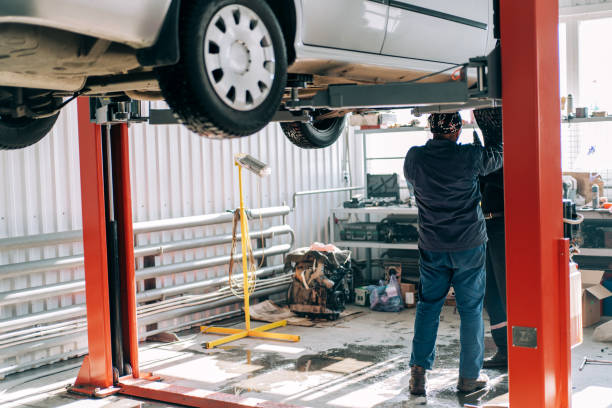
You need to match real vehicle weight with safe operating limits and your daily workflow. Bay size, ceiling height, and vehicle mix also matter. If these do not align, even a high-capacity car lift can become inefficient or unsafe in practice.
Why Rated Capacity Alone Is Not Enough
Lift ratings are based on controlled test conditions. They assume perfect balance and ideal lift points. Real shop conditions are different. Vehicles carry fuel, cargo, and equipment. Weight is often uneven. These factors reduce real usable capacity. Relying only on the rated number can lead to poor equipment selection.
How to Apply Safe Operating Margins
You should always leave a safety buffer when selecting lift capacity. A common rule is to choose a lift with 15–25% more capacity than your heaviest vehicle. This reduces stress on the system over time. For daily use, staying around 75% of rated capacity improves stability and extends equipment life. On two-post lifts, each arm must also be properly balanced to avoid uneven load stress.
Matching Lift Capacity to Vehicle Types
Lift capacity should match your actual vehicle types. Light passenger cars and small SUVs usually fit 9,000–10,000 lb lifts. Full-size pickups and light diesel trucks often require 11,000–12,000 lb capacity. For heavier vehicles like 1-ton trucks, dually pickups, and service bodies, 14,000–18,000 lb lifts are more appropriate for safe operation.
Considering Vehicle Size and Shop Constraints
Vehicle dimensions are just as important as weight. Wheelbase length and width determine how safely a vehicle fits on the lift. Column spacing also affects access and stability. Ceiling height is another key factor. Shops with tall vans or commercial vehicles typically need at least 11–12 feet of clearance to maintain safe and efficient workflow.
Elevate Workshop Safety With Heavy-Duty Lifts
How Shop Space and Ceiling Height Influence Lift Installation
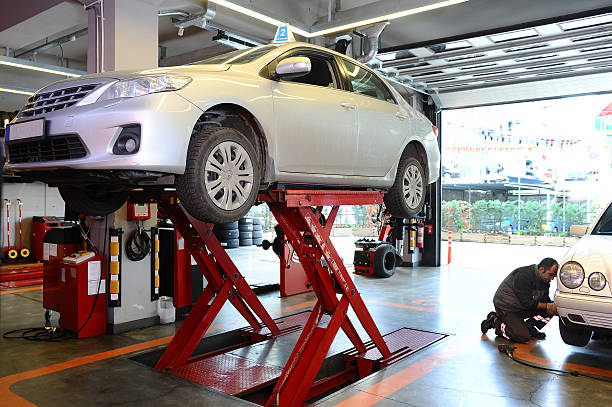
Calculating Required Ceiling Clearance
You cannot guess your ceiling height requirements. To calculate the exact vertical clearance needed, add the lift’s maximum rise to the vehicle’s height from the lifting point, then add a 4 to 12-inch safety margin. Standard full-rise automotive lifts demand an absolute minimum ceiling height of 11 to 12 feet. If your shop services taller trucks, vans, or SUVs, you need up to 14 feet of vertical space to work comfortably.
Impact on Lift Type Selection
Your ceiling height directly restricts which lift mechanisms you can install safely.
- Two-post overhead lifts: Require higher ceilings to clear the crossbeam.
- Baseplate models: Route cables across the floor to fit under 9.5-foot ceilings.
- Four-post lifts: Used for vehicle stacking, demanding precise calculations that factor in runway thickness, lock clearance, and combined vehicle heights.
- Mid-rise and scissor lifts: Provide practical alternatives for low-clearance garages limited to 8 to 10 feet of headroom.
Horizontal Space and Bay Layout Requirements
A lift’s footprint is only part of the equation. The operating envelope must account for adequate door swing clearance, positioning arms, and a clear path for vehicle approach. Standard service bay widths of 12 to 14 feet provide technicians enough room to maneuver toolboxes, jacks, and alignment equipment. Proper horizontal planning ensures structural columns do not interfere with adjacent work zones or load-bearing facility walls.
Managing Overhead Obstructions and Hazards
Building infrastructure frequently restricts usable vertical height. HVAC ductwork, fire sprinklers, ceiling fans, and light fixtures act as hard limits on your maximum lifting capacity. Standard garage door openers often interfere with lifting paths, making high-lift or vertical-lift door tracks necessary in many installations. You can reclaim critical inches for safe operation by replacing low-hanging light fixtures with flush-mount alternatives and rerouting overhead conduit.
Structural Floor Planning and Anchor Clearances
Space planning goes beyond the air above the lift; it directly influences structural floor requirements.
- Anchor constraints: Lift columns must maintain safe anchor edge distances from walls, drains, and slab borders.
- Concrete specifications: Slabs within the operating footprint must meet strict depth and compression strength criteria, typically requiring at least 4 inches of thickness and 3,000 PSI.
- Spacing penalties: Inadequate horizontal spacing limits your ability to safely anchor heavy-duty post lifts and forces expensive concrete repouring.
How to Choose the Right Vehicle Lifts for Your Workshop
Assess Your Vehicle Mix and Weight Requirements
You need to know exactly what is rolling into your bays before buying equipment. Start by pulling the Gross Vehicle Weight (GVW) from the OEM documentation of your heaviest typical customer or fleet vehicle.
- Workload categories: Determine if your shop handles mostly light-duty sedans, medium-duty crossovers, or heavy-duty commercial vans.
- Weight distribution: Account for front-heavy diesel trucks or rear-loaded cargo vans that severely alter the lifting balance.
A 10,000-pound lift fails if an imbalanced cargo van overloads the rear arms. Buy capacity based on the worst-case weight distribution your technicians see weekly.
Select the Appropriate Lift Configuration
Different service jobs demand different lift architectures. You cannot maximize efficiency by forcing a general-purpose lift to do alignment or quick-lube work.
- Two-post lifts: Provide unrestricted underbody and wheel access for suspension, exhaust, and general mechanical repairs.
- Four-post lifts: Deliver drive-on stability tailored for wheel alignments, fluid services, and long-term vehicle stacking.
- Scissor lifts: Save critical space in low-ceiling environments while handling quick-service tire and brake lanes.
- Mobile columns & inground setups: Offer flexibility and an uncluttered floor specifically for heavy-duty fleet depots.
Match the tool to the bay’s primary revenue stream. Two-posts dominate mechanical repair, but four-posts win for rapid drive-on inspections.
Evaluate Space and Structural Constraints
A high-capacity lift is useless if your shop cannot safely house it. Vertical and horizontal clearances define your operating envelope.
- Ceiling height: Measure clearance for both the lift carriage mechanisms and the tallest vehicle roof you service.
- Bay layout: Guarantee adequate floor space for approach paths, open vehicle doors, and technician movement.
- Concrete slab limits: Verify your floor meets the lift manufacturer’s exact specifications for minimum thickness and compressive strength.
Thin or unreinforced concrete will fail under heavy two-post loads. Never anchor a commercial lift to a weak residential-style slab.
Prioritize Safety Certifications and Capacity Margins
You cannot cut corners on equipment that suspends tons of steel above your technicians. Independent verification separates professional gear from dangerous liabilities.
- Required standards: Mandate Automotive Lift Institute (ALI) and ETL certification labels to guarantee independent structural safety compliance.
- Capacity buffer: Select a lift capacity that exceeds your heaviest vehicle by at least 15%, or roughly 1,000 to 1,500 pounds.
- Operating limit: Aim to operate the equipment at roughly 75% of its maximum rated capacity to reduce structural stress.
Running a lift consistently at its absolute limit accelerates wear. Building in a heavy capacity margin extends service life and protects your mechanics.
Common Mistakes Shops Make When Choosing Vehicle Lifts
Choosing the Wrong Lift for Vehicle Requirements
Many shops choose a lift that does not match their real vehicle mix. This becomes more obvious over time as fleets shift toward heavier EVs, larger SUVs, and commercial trucks.
Vehicle geometry is often overlooked during selection. Wheelbase, track width, and lift point positions all affect how a vehicle sits on the lift. If these are not aligned, positioning becomes slower and less stable. Even a properly rated lift can feel difficult to use in daily operations.
Ignoring Facility and Installation Constraints
A lift must match the physical conditions of your shop. If it does not, both safety and efficiency will be affected. Ceiling height is one of the first constraints to check. Low beams, lighting fixtures, or garage doors can limit usable lifting space.
Concrete condition is just as important. Thin slabs, weak reinforcement, or nearby joints can reduce anchoring strength and long-term stability. Bay layout also influences daily workflow. Poor positioning reduces movement space and slows technician access. Electrical capacity should not be assumed. Some lift systems require 220V or three-phase power. Older facilities may need upgrades before installation is possible.
Overlooking Safety Certification and System Design
Safety certification is a baseline requirement for professional shop use. ALI/ETL certified lifts are tested by third parties for structural strength and long-term reliability. Uncertified equipment may look cost-effective at first. However, it increases operational risk and may create compliance issues with insurance or local regulations.
Safety systems also play a critical role. Mechanical locks provide load-holding security. Hydraulic flow control stabilizes movement during operation. Cable synchronization ensures even lifting across all points. Together, these systems reduce the risk of failure in daily use.
Focusing Only on Purchase Price Instead of Total Cost
The purchase price of a lift is only part of the total investment. Real cost becomes clear over time through maintenance, downtime, and repair frequency. Lower-cost equipment often requires more frequent servicing. This reduces bay availability and directly affects shop revenue. In contrast, higher-quality systems maintain stability over a longer period. This helps ensure consistent workflow and reduces unexpected operating disruptions.
Final Thoughts
Proper vehicle lift selection is a critical engineering decision that directly impacts shop safety, workflow efficiency, and long-term operating cost. Uncertified or poorly matched equipment increases compliance risk, raises downtime exposure, and can restrict future operational growth. A reliable configuration depends on aligning real vehicle mix, facility conditions, and structural capacity rather than relying on price or assumptions.
At ग्वारेंज, we specialize in professional vehicle lift solutions engineered around real workshop conditions, including concrete specifications, vehicle load profiles, and operational layout requirements. Our focus is to support safer and more efficient service environments with properly matched lift systems from the outset.
👉Contact our team today to get expert support and identify the right configuration for your facility.
Frequently Asked Questions
2-post vs 4-post lifts: which is safer?
Both lift types are safe when you install them properly and use them within their rated capacities. But 4-post lifts are structurally more forgiving and inherently stable because the vehicle rests on its tires across four wide columns. They offer the safer option for heavy-duty vehicles, mixed-experience staff, and long-term storage. Two-post lifts work perfectly for professional repair shops but demand strict adherence to proper lifting points and weight distribution.
Can I install a vehicle lift on a 4-inch concrete slab?
A solid, uncracked 4-inch slab at 3,000 PSI or higher usually supports standard 4-post parking lifts, portable scissor lifts, and explicitly approved light-duty 2-post lifts (typically 8,000–10,000 lb capacity). Heavy-duty 2-post lifts and commercial fleet lifts require 6 to 8 inches of concrete. Always verify your specific lift manufacturer’s installation manual and confirm the actual thickness and condition of your concrete before anchoring.
How high does my ceiling need to be for a vehicle lift?
You calculate required ceiling clearance by adding the lift height, the vehicle height, and a buffer room for overhead obstructions like lights and garage door tracks. Standard 2-post lifts typically require 11 to 12 feet of clearance. Storage-oriented 4-post lifts need 9 to 10 feet, while low-rise and portable scissor lifts operate easily with 8 to 10 feet of ceiling height.
What is the best lift for a home garage?
The right home garage lift depends entirely on your primary use and space limitations. If you want to stack vehicles for storage and perform basic maintenance, pick a 4-post lift. If you do heavy mechanical and undercarriage work and have adequate ceiling height, a 2-post lift offers the most efficiency. For low-ceiling garages or minimal floor space, portable frame lifts or mid-rise scissor lifts provide excellent alternatives.
How often do vehicle lift cables need replacement?
Industry standards recommend replacing vehicle lift cables every 3 to 5 years, depending on usage volume and shop environment. Condition always overrides age. You must replace cables immediately if you spot a 10% reduction in diameter, multiple broken wires, severe rust, pitting, kinking, or structural deformation.
What is the difference between a “Clear-floor” and “Base-plate” 2-post lift?
The main difference comes down to how the lift routes hydraulic lines and equalizer cables. A clear-floor (overhead) lift runs these cables through a top crossbar. This leaves the floor completely open for rolling equipment, but it requires taller ceilings (usually 12 feet or more). A base-plate (floor-plate) lift routes the cables across the floor beneath a low, beveled steel plate. This setup fits well in low-ceiling garages, though it creates a minor hump for technicians to roll jacks and tool carts over.


