

Pre-shipment inspection is the last opportunity to identify defects, missing items, or configuration errors before the car lift leaves the factory. A systematic inspection reduces the risk of receiving equipment that does not meet your order specifications, safety requirements, or performance expectations.
This guide provides a comprehensive checklist for inspecting car lifts before shipment, covering structural integrity, hydraulic systems, safety functions, load test evidence, accessories, documentation, and packaging. The goal is to help you verify that the equipment matches your order before authorizing shipment.
Define the Inspection Scope and Acceptance Criteria
Before the inspection begins, define what will be inspected, how it will be inspected, and what constitutes acceptable quality. This prevents disputes and ensures that both parties understand the acceptance criteria.
| Planning Dimension | What to Define | Why It Matters |
|---|---|---|
| Inspection scope | All items in the order: lift unit, HPU, cylinders, hoses, fittings, electrical components, safety devices, adapters, tools, spare parts, manuals, certificates | Prevents gaps between buyer expectations and supplier delivery |
| Acceptance criteria | Visual standards (no scratches, dents, paint defects); dimensional tolerances; functional requirements; documentation completeness | Agreed in PO/contract before production begins — eliminates post-delivery disputes |
| Inspection method | Who performs it (buyer, third-party inspector, supplier QA); visual only or functional testing; location (factory vs. third-party facility) | Clarify before the inspection date to avoid scheduling conflicts and scope creep |
Confirm the Model, Capacity, Voltage, and Order Configuration
The first step in the inspection is to verify that the equipment matches the order specifications: model number, rated capacity, electrical configuration, and any custom features.
| Verification Item | What to Check | Common Issue |
|---|---|---|
| Model number | Nameplate vs. purchase order | Similar-looking models with different capacities; visual appearance is unreliable |
| Rated capacity | Nameplate rating (e.g., 3,000 / 4,000 / 5,000 kg) | Supplier substitutes a lower-capacity model claiming equivalence |
| Electrical configuration | Voltage, frequency, phase on nameplate and in panel (e.g., 220V/50Hz/1-phase) | Motor or control board not reconfigured for target market standard |
| Custom features | Special colors, custom nameplates, modified platform dimensions, adapter types, control systems | Custom request overlooked in production or incorrectly implemented |
Inspect Structural Parts, Welds, Fasteners, and Surface Finish
Structural integrity is critical for car lift safety. Inspect all structural parts, welds, fasteners, and surface finish for defects that could compromise strength or durability.
| Inspection Area | What to Check | Defect = Risk |
|---|---|---|
| Main structural components | Columns, base plate, crossbeam, platform: cracks, bends, dents, deformation; steel thickness vs. specification; critical dimensions | Reduced load-bearing capacity; catastrophic failure under weight |
| Weld quality | Continuity, uniformity, absence of cracks/porosity/incomplete fusion; focus on column-to-base, crossbeam-to-column, platform-to-carriage | Welds can fail under repeated load cycles; serious safety hazard |
| Fasteners | Torque specification met; lock washers, lock nuts, or thread-locking compound present where required; none missing or loose | Components shift or separate during operation; structural integrity compromised |
| Surface finish | Paint, powder coating, or plating: scratches, chips, bubbles, uneven coverage | Corrosion starts at bare metal; minor cosmetic defects acceptable, severe ones require rework |

Check Cylinders, Hoses, Fittings, and Hydraulic Leakage
The hydraulic system is the heart of the car lift. Inspect all hydraulic components for defects, proper installation, and leakage.
| Component | What to Inspect | Acceptance Criteria |
|---|---|---|
| Hydraulic cylinders | Dents, scratches, corrosion, leaking seals; rod straightness and scoring; mounting alignment | No visible defects; rods smooth and free of scoring; mounting secure |
| Hoses | Routing, secure mounting, kinks, abrasion, damage; pressure rating; fluid compatibility | No kinks or damage; correctly rated for system pressure; securely mounted |
| Fittings (elbows, tees, adapters) | Material, pressure rating, crimp quality, tightness | Properly crimped and tightened; rated for system pressure; no missing components |
| Full system leak test | Operate through complete cycles (raise, lower, intermediate stops); inspect all connections | Zero visible leakage at any point in the cycle |
Test Locks, Limit Controls, Emergency Stop, and Emergency Lowering
Safety devices are critical for protecting the operator and the vehicle. Test all safety functions to verify that they operate correctly.
| Safety Function | Test Procedure | Pass Criteria |
|---|---|---|
| Mechanical locks | Raise to various heights and engage; attempt to lower with locks engaged | Locks hold securely; platform must not move; locks disengage smoothly |
| Upper/lower limit switches | Raise to max height and lower to min height | Lift stops automatically at both extremes without over-travel |
| Emergency stop | Press button while lift is in motion | Stops immediately; cuts power to pump; holds platform; resets correctly |
| Emergency lowering | Simulate power failure (disconnect or use manual lower) | Platform lowers slowly and controllably to ground level |
For capacity specifications before ordering, see how much weight your lift should handle. Browse the car lift product range to confirm model and capacity options.
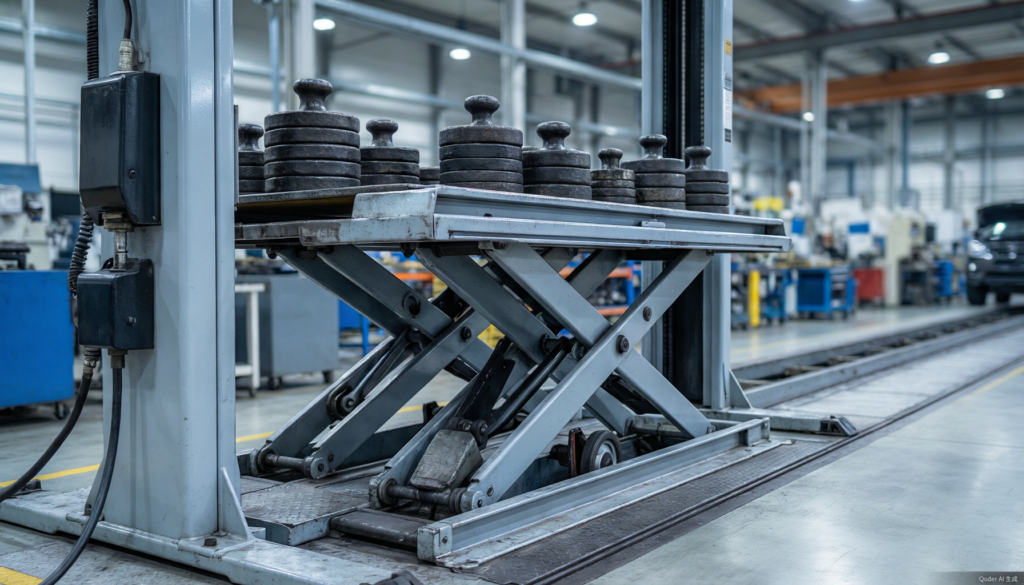
Verify Load Test Evidence and Calibration Records
Load testing and calibration verify that the lift performs to its rated capacity and that the safety systems function correctly. Review the test evidence before accepting the equipment.
| Evidence Type | What to Request | What to Review |
|---|---|---|
| Load test report | Full test record: test date, applied load, duration, results | Rated capacity achieved without deformation, leakage, or safety failure; test method matches applicable standard |
| Calibration records | Certificate for torque wrenches, pressure gauges, dimensional tools used during production | Equipment was calibrated and within tolerance at the time of use |
| Third-party certifications | CE, UL, or other market-required certificates (if applicable) | Correct model number, manufacturer, and standard; not expired |
| Witnessing options | Live demonstration, video evidence, or third-party inspector report | Video is better than nothing, but independent verification is stronger than self-reported results |
Inspect Accessories, Tools, Pezzi di ricambio, and Documentation
Accessori, tools, spare parts, and documentation are often overlooked during inspection but are essential for equipment operation and maintenance.
| Categoria | What to Verify | Impact if Missing |
|---|---|---|
| Accessori | Truck adapters, extension adapters, jack trays, wheel chocks, restraints, drip trays — each undamaged and matching specifications | Cannot service full vehicle range; additional procurement delay |
| Installation tools | Alignment tools, calibration tools, special wrenches, lifting equipment | Installation or maintenance delayed; may require local sourcing |
| Spare parts | Seals, O-rings, filters, fuses, wear parts — correctly labeled and packaged | First breakdown causes extended downtime without on-hand spares |
| Documentation | User manuals, installation guides, wiring diagrams, hydraulic schematics, compliance certificates, test reports in correct language | Compliance issues, installation errors, warranty disputes |
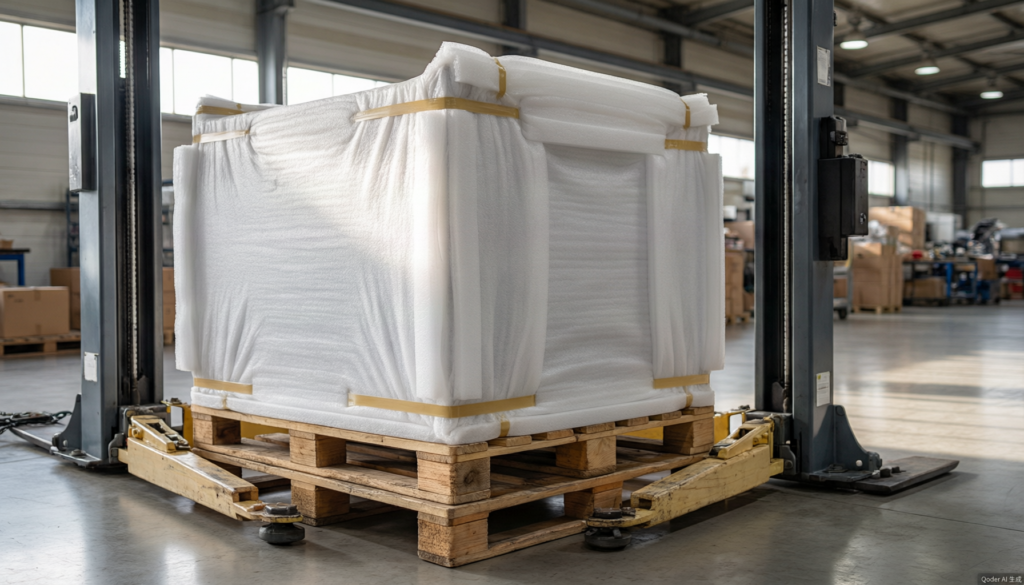
Check Packaging, Marking, and Shipping Preparation
Proper packaging and marking protect the equipment during shipping and ensure that it arrives at the correct destination in good condition.
| Packaging Aspect | What to Verify | Risk if Inadequate |
|---|---|---|
| Mounting and cushioning | Equipment securely fixed on pallet/crate; fragile parts (cylinders, electrical panels, safety devices) wrapped in foam or bubble wrap | Transit damage from movement, stacking, or rough handling |
| Package marking | Buyer name, destination address, PO number, package number (e.g. “1 of 5”); legible and on multiple sides | Shipping delays, mis-delivery, or lost packages at destination port |
| Shipping preparation | Hydraulic fluid drained (if required), electrical connections disconnected, moving parts secured, rust prevention applied, exposed surfaces covered | Corrosion, component damage, or safety hazards during handling |
| Sea-freight protection | Vacuum sealing, desiccant packs, or corrosion-inhibiting coatings for ocean transit | Saltwater and humidity cause corrosion during multi-week shipping |
If you are still selecting a supplier, see how to evaluate a car lift manufacturer and our wholesale car lifts buying guide.
Pre-Shipment Inspection Checklist
Use this checklist to organize your pre-shipment inspection and ensure that all critical items are verified.
| Inspection Category | Key Items to Verify |
|---|---|
| Order configuration | Model number, rated capacity, voltage/frequency, custom features. |
| Structural integrity | No cracks, bends, or dents; weld quality; fastener tightness; surface finish. |
| Hydraulic system | Cylinder condition; hose routing and mounting; fitting tightness; no leakage. |
| Safety functions | Mechanical locks; limit controls; emergency stop; emergency lowering. |
| Load test evidence | Load test report; calibration records; third-party certificates (if required). |
| Accessories and spare parts | All ordered accessories present; tools included; spare parts packaged correctly. |
| Documentation | User manuals; installation guides; programmi di manutenzione; warranty cards; certificates. |
| Packaging and marking | Secure mounting; adequate protection; correct marking; shipping preparation. |
Complete this checklist before authorizing shipment. If any item fails inspection, document the deficiency and require corrective action before shipment. Shipping defective equipment increases the cost and complexity of resolution (return shipping, rework, replacement) and delays your project timeline.
If you’re also evaluating car lift safety features, our guide to car lift safety features explains the safety functions and test methods in more detail. The pre-shipment inspection verifies that these safety features are present and functional before the equipment leaves the factory.
Domande frequenti
What should be included in a pre-shipment inspection?
A pre-shipment inspection should verify the order configuration (model, capacity, voltage), structural integrity (welds, fasteners, finish), hydraulic system (cylinders, hoses, fittings, leakage), safety functions (locks, limits, emergency stop), load test evidence, accessories and spare parts, documentation, and packaging. The inspection ensures that the equipment meets your requirements before it leaves the factory.
How do you inspect structural parts and welds?
Inspect structural parts for visible defects: cracks, bends, dents, or deformation. Check steel thickness and measure critical dimensions if required. Examine all welds for quality: continuous, uniform, free of cracks or porosity. Pay special attention to critical welds (column-to-base, crossbeam-to-column). Check fasteners for proper installation and tightness. Inspect surface finish for scratches, chips, or uneven coverage.
What hydraulic components should be checked?
Check hydraulic cylinders for dents, scratches, corrosion, or leaking seals. Verify that cylinder rods are straight and smooth. Inspect hoses for proper routing, secure mounting, and absence of kinks or damage. Check fittings for proper installation and tightness. Test the hydraulic system for leakage by operating the lift through several complete cycles. No visible leakage is acceptable.
Which safety functions must be tested?
Test mechanical locks (engage and disengage at various heights), limit controls (upper and lower limits stop the lift automatically), emergency stop (lift stops immediately when pressed), and emergency lowering (platform lowers controllably during power failure). All safety functions must operate correctly before the equipment is accepted.
What documentation should be verified?
Verify that all required documentation is included: user manuals, installation guides, programmi di manutenzione, parts catalogs, wiring diagrams, hydraulic schematics, warranty cards, compliance certificates (CE, UL, ecc.), and load test reports. Check that each document is present, completare, and in the correct language. Missing documentation can delay installation or create compliance issues.
How long does a pre-shipment inspection of a car lift typically take?
A thorough inspection of a two-post or four-post car lift usually takes 2–4 hours per unit. The time depends on the model, whether a load test must be witnessed or repeated, and how many accessories and documents need to be matched against the order. First-run configurations and custom builds typically require more checking than repeat orders of an established model. When a third-party agency is involved, allow extra days for scheduling, factory coordination, and written report preparation.
Can a third-party inspection company perform the check on my behalf?
SÌ. Many importers use firms such as SGS, Bureau Veritas, Intertek, or regional agencies to check car lifts at the factory. Provide the inspector with your acceptance criteria, order confirmation, target photographs, and a copy of any prior sample so the check follows your specification rather than a generic template. Ask for a written report with photographs that covers structural components, hydraulic fittings, safety functions, load test evidence, accessories, and packaging before shipment is authorised.
What should I do if the inspection finds non-conformities?
Document every finding with a photograph, a short description of the issue, and its severity. Classify items as critical (safety, capacity, wrong model), major (missing accessories, hydraulic leakage, incorrect voltage), or minor (cosmetic marks, packaging labels). Share the report with the supplier before shipment authorisation and agree on a correction plan with deadlines. Re-inspect any critical or major item that has been reworked. Cosmetic minor issues can be accepted under a written concession rather than an informal email.
Is a witnessed load test always required before a car lift ships?
Not always, but a witnessed test is strongly recommended for first-time orders, custom capacity builds, and heavy-duty models. Most manufacturers can perform a factory test at 100% of rated capacity, or at 115% as a proof load, and provide a signed record with photographs. If a physical test cannot be arranged, request the calibration certificate for pressure gauges, prior test reports for the same model, and written confirmation that safety valves, mechanical locks, and emergency lowering have been function-tested before packing.


