
Sourcing wholesale 휠 밸런서 requires matching machine specifications to the workshop tolerances your customers face daily. Selling machines with inconsistent clamping or imprecise sensor readings leads to elevated warranty claims, turning a profitable distributor account into a cost center.
This guide maps the purchasing decision from three angles: which machine categories address distinct buyer needs, how to verify accuracy through supplier documentation, and how to structure trade terms—MOQ, lead times, 포장, and after-sales—for a distributor’s cash-flow cycle. For the measurement principles behind accuracy claims, see our companion on how a wheel balancer measures imbalance.
Which Customers and Vehicles Will the Machines Serve?
Wholesale balancers flow into distinct professional segments. Shop volume and the vehicle mix—passenger, commercial, performance—determine the machine configurations a distributor should stock.
Machines serve a range of professional workshop environments, each with different throughput and precision demands:
- 독립 수리점: A common customer segment, typically needing versatile balancers that handle routine tire rotations and multi-brand repairs.
- High-volume tire retail chains: Often prioritize semi-automatic or fully automatic balancers for rapid bay turnover.
- 대리점: Some use diagnostic balancers where required by their service procedures; capability needs vary by brand and region.
- Commercial fleets and assembly plants: Require heavy-duty or inline high-precision balancers with reinforced shafts and large-diameter capacity.
Applications range from compact steel rims on passenger cars and SUVs to commercial assemblies over 22.5 신장. Motorcycle, racing, and mobile-service niches require narrow-rim adaptors or compact portable units. Before placing a wholesale order, profile the heaviest and most complex wheel assemblies your target customers encounter daily—then confirm the machine’s stated rim-diameter range, maximum wheel weight, and available adaptors cover that profile.
A distributor’s inventory risk rises when one machine tier is expected to serve all segments. Stocking to a single profile forces either over-specifying (paying for capability a budget shop never uses) or under-specifying (delivering a basic unit to a buyer that expects advanced diagnostics). Segment the catalog early, and align each SKU with a defined end-user need.
Which Wheel Balancer Types Should a Distributor Stock?
Wheel balancers are classified along three independent dimensions—application, 자동화 수준, and diagnostic capability. A structured product mix addresses each dimension deliberately rather than conflating them.
| Dimension | Categories | What to Verify |
|---|---|---|
| By Application | Passenger car/SUV • Motorcycle • Commercial truck • Mobile service | Rim diameter range, max wheel weight, available adaptors and cone sets |
| By Automation Level | Manual data entry • Semi-automatic measurement • Fully automatic data capture | Cycle-time impact on throughput; operator training burden across shifts |
| By Diagnostic Capability | Standard spin balancing • Load-roller road-force analysis | Whether the machine uses a true powered roller pressing against the tread, or is a standard balancer marketed with similar terminology |
These dimensions overlap freely: a fully automatic passenger-car balancer may or may not include road-force capability. When building a catalog, decide which combinations your target segments actually demand, then match suppliers accordingly.
If road-force diagnostics is required by your buyers, confirm whether the supplier offers a true load-roller diagnostic system rather than a standard spin balancer marketed with similar terminology. Request the model’s specification sheet showing the roller force rating, measurement protocol, and how RFV output is displayed or exported.
When specifying machines across tiers, request the manufacturer’s data sheet for each model. Key items to compare include the stated balancing resolution (often expressed at the gram level), maximum wheel weight and rim diameter range, and cycle-time figures. Treat these as model-dependent benchmarks; actual shop throughput depends on operator workflow as well as machine capability.
Which Wheel and Rim Specifications Must a Machine Cover?
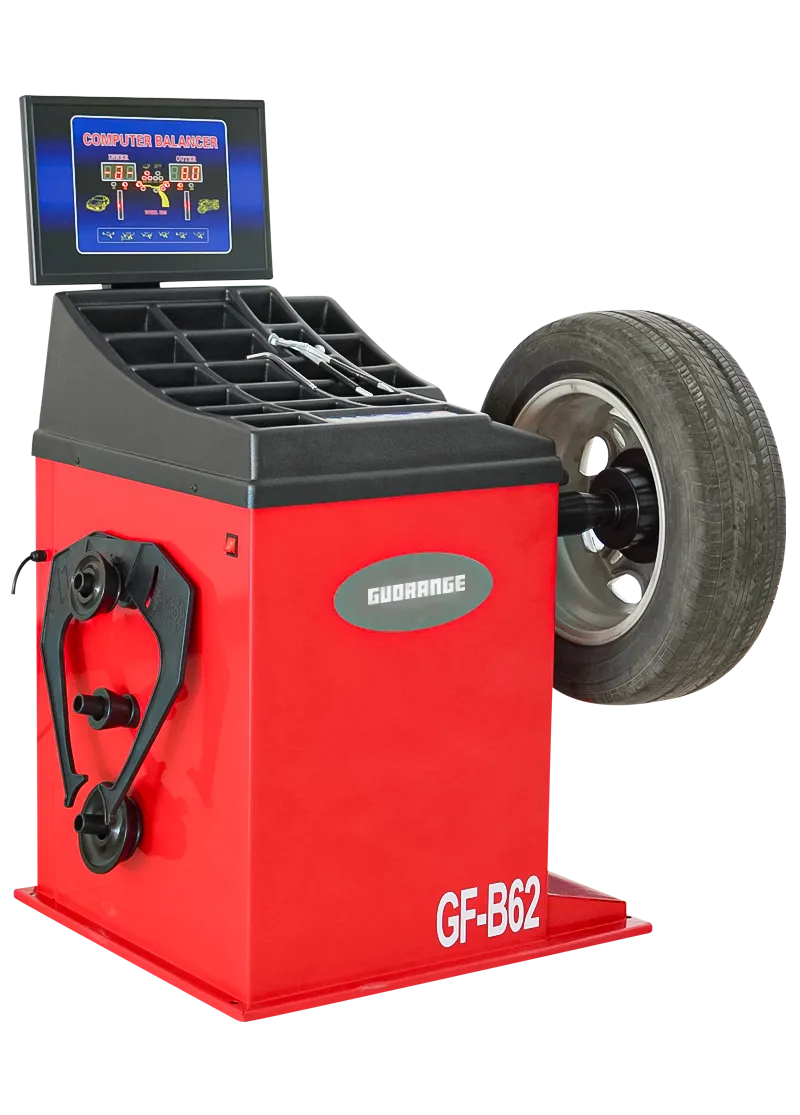
The machine’s dimensional range and clamping hardware must match the wheels your customers actually service. A mismatch between rim profile and available adaptors produces unreliable readings regardless of sensor quality.
Confirm the balancer’s stated operating envelope covers your target market:
- Rim diameter and width range: Match the machine’s minimum-to-maximum span against the wheel sizes your customers run—from compact steel rims through wide low-profile alloys.
- Maximum assembly weight: Verify the rated capacity covers fully mounted tire-plus-rim assemblies without straining the spindle or motor.
- Offset and inner-plane distance: The distance gauge arm must reach deep-dish or heavily offset rims to set correction planes accurately.
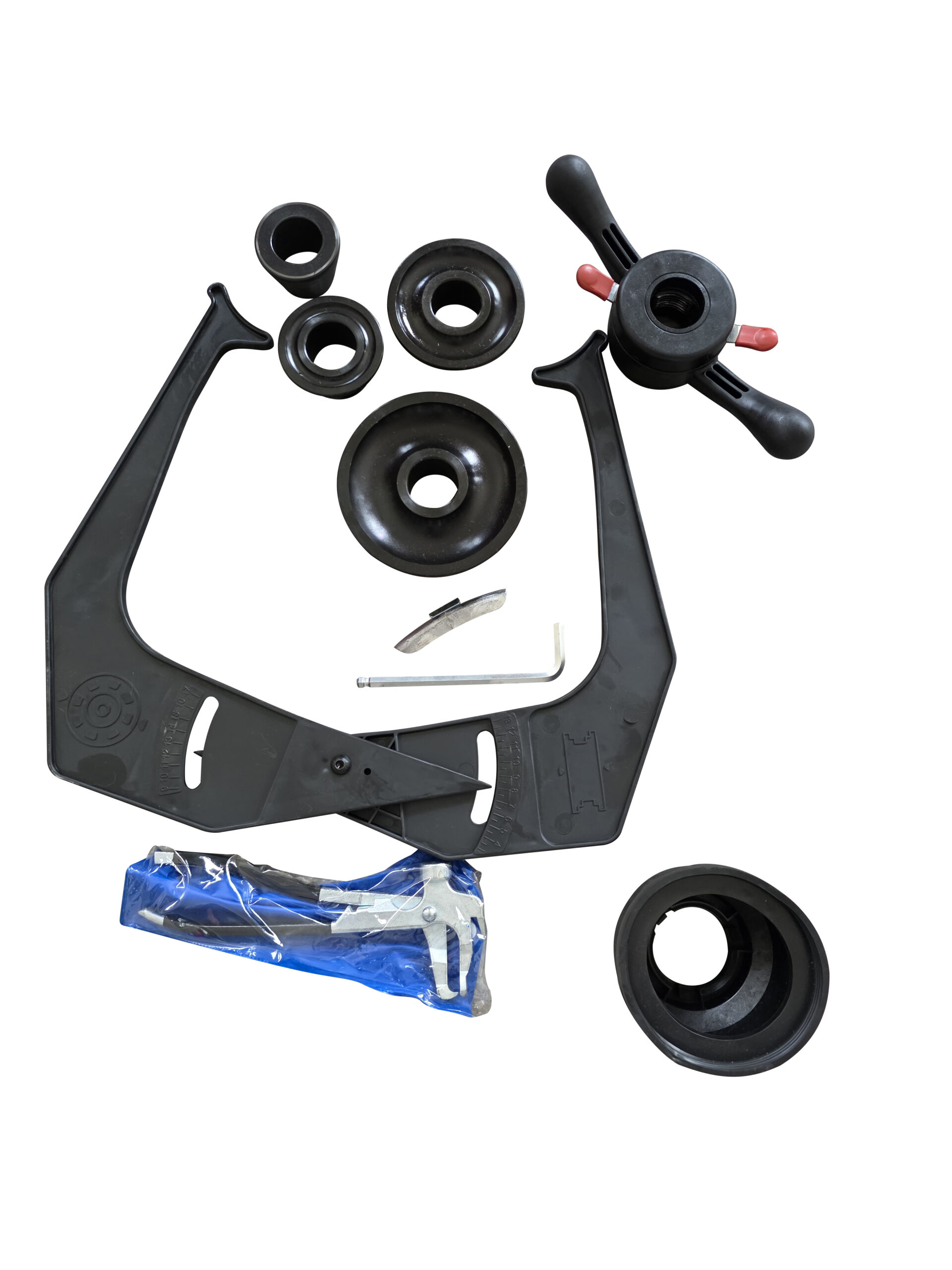
- Center-bore and hub compatibility: Stock the correct centering cones or hub-specific adapters for the brands your customer base services; an ill-fitting cone introduces off-axis error before the spin even starts.
Beyond dimensional fit, pre-balance wheel condition matters: remove old weights, clean debris, verify proper inflation, and inspect for severe runout. Advanced sensors cannot compensate for a bent rim or contaminated mating surface.
Which Measurement and Operating Functions Affect Shop Efficiency?
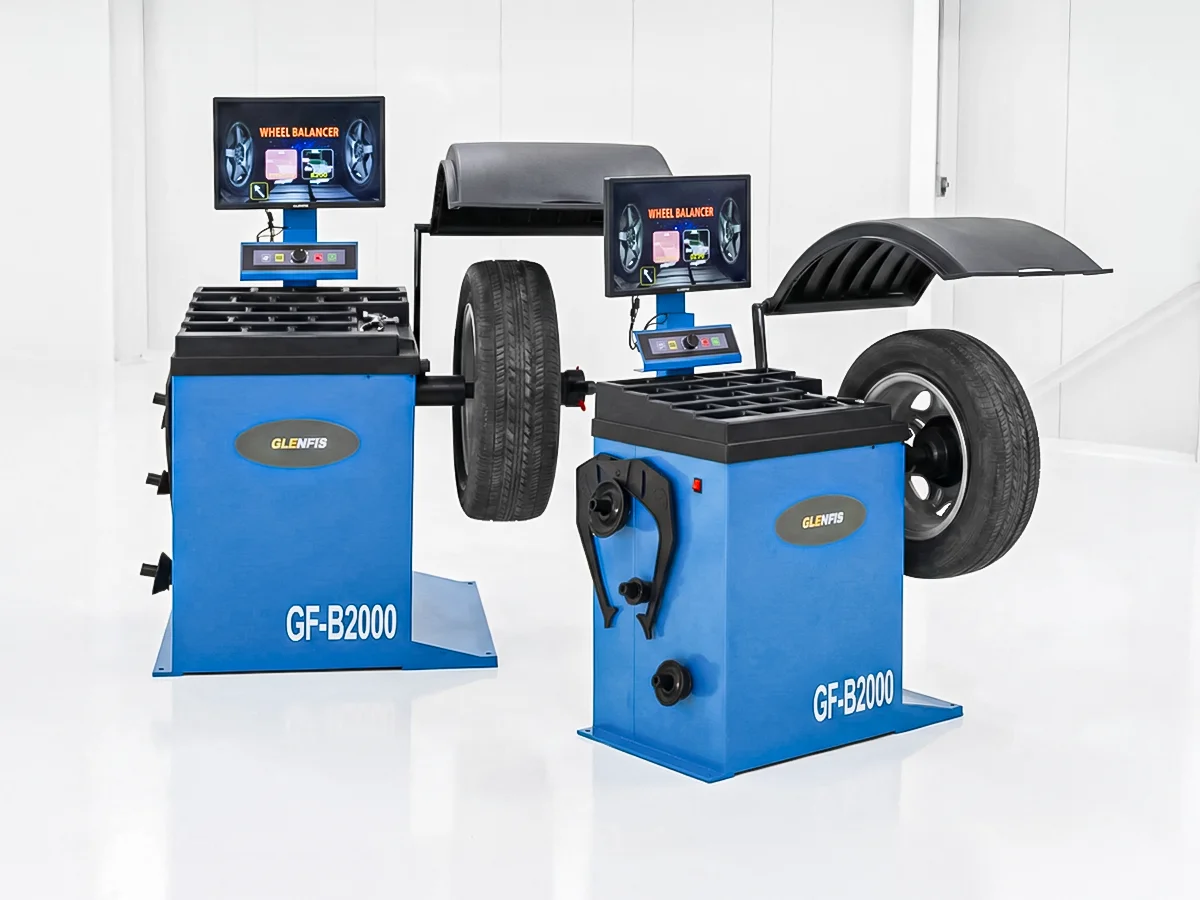
Function level determines the customer segment a machine serves. Core dynamic balancing is the professional baseline; automatic data entry, power clamping, and optional road-force simulation expand diagnostic reach for buyers who require them.
- Dynamic two-plane measurement: Separates static and couple imbalance across inner and outer planes—the baseline function professional-grade balancers include.
- Automatic data entry and power clamping: Sonar or mechanical gauges measure distance, diameter, and width; electromechanical clamps apply consistent force. These features reduce operator-dependent variability across multiple shifts.
- Laser and LED placement guidance: Projects correction location directly on the rim—useful on deep-dish or multi-spoke wheels where finding a clip point by eye wastes time.
- Road-force load simulation (diagnostic tier): A load roller presses against the tire tread while the assembly rotates, allowing the machine to identify radial force variation and other tire-and-wheel conditions that weight correction alone may not resolve. Not every supplier offers this capability—verify the exact measurement functions before assuming it is included.
Resolution, cycle time, and angular accuracy figures are model-specific; always compare against the manufacturer’s published data sheet rather than a generic industry benchmark.
For a distributor, map each feature tier—basic dynamic, auto-data-entry, and optionally road-force—to a distinct customer profile before finalizing the inventory mix, so that each machine addresses a clearly defined buyer segment.
How Should You Verify Accuracy Before Committing to a Bulk Order?
A distributor’s role is to require verifiable documentation and validate a sample unit against the manufacturer’s own test procedure—not to invent a universal acceptance protocol.
Requesting and Reviewing Supplier Documentation
The first step is to obtain and cross-check the manufacturer’s test documentation for the exact model and configuration being ordered:
- Data sheet and calibration procedure: Request the model’s stated tolerance thresholds, recommended calibration wheel, test-weight mass, mounting adapter, and weight position. Use the manufacturer’s specified procedure as your acceptance reference rather than a generic set of numbers.
- Factory QC evidence: Ask what per-unit or per-batch inspection records the supplier can provide. Not all factories issue individual calibration reports; clarify what documentation comes with the shipment before the order is placed.
- Conformity and market-access documents: Confirm the conformity documents, test reports, labeling, and declarations required by the destination market. Verify that every document identifies the exact machine model and electrical configuration being ordered—marks cannot be treated as interchangeable OEM sticker options.
Validating a Sample Unit
Before releasing a container order, procure one evaluation sample and run a practical verification on your own bench:
- Baseline spin: Mount a known-balanced reference wheel and perform a spin with no added weight. The indicated residual should fall within the model’s declared tolerance.
- Known-weight detection: Apply the manufacturer’s specified test weight at the prescribed position. Verify that indicated magnitude and angular position remain within the model’s stated accuracy.
- Remount repeatability: Remove the wheel, remount it at a different angular position relative to the adapter, and repeat the measurement. Large variations may indicate mounting or centering problems rather than sensor error.
- Spin-to-spin stability: Run consecutive spins without unclamping. Display variation should stay within the manufacturer’s stated per-plane repeatability figure.
Record all results and compare them against the data sheet. If the sample passes, freeze the specification for the bulk order. If it does not, resolve discrepancies with the supplier before committing production capacity.
What Localization and Private-Label Options Are Available?
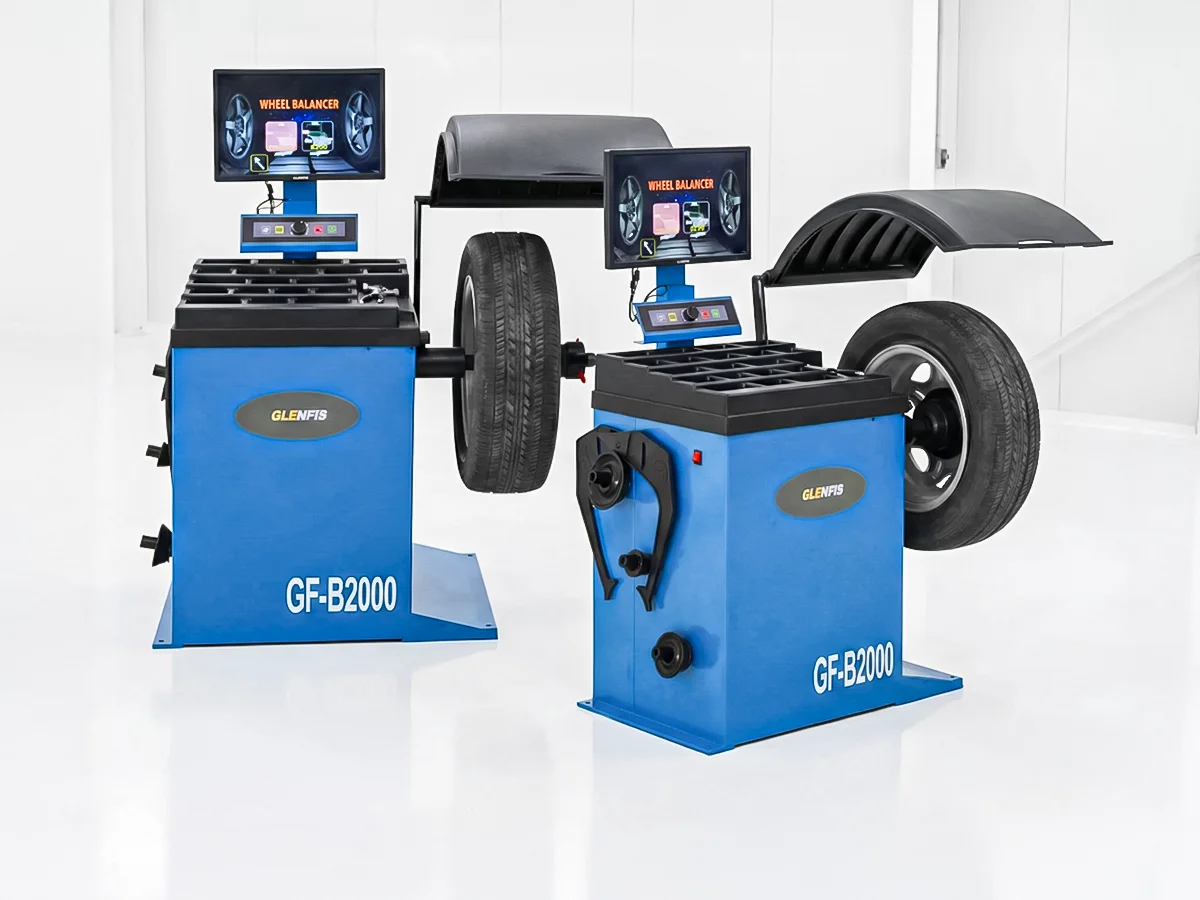
OEM and private-label options vary by supplier and order quantity. Confirm the scope, MOQ, and timeline of any branding program before negotiating artwork or packaging commitments.
Private-Label Branding and Packaging
Where programs are available, distributors can apply their own badging, color accents, printed shipping cartons, and branded manuals to an existing balancer platform. Typical scope covers logo plates, fascia colors, co-branded literature, and retail-ready packaging—allowing a machine to slot into an established sales channel without bespoke engineering.
Technical Localization for Regional Markets
Export-ready machines must match destination requirements: voltage and frequency configuration, multilingual software and labels, region-specific safety documentation, and barcode or SKU schemes for the receiving warehouse. Confirm that all compliance labeling reflects genuine test evidence for the exact configuration shipped—marks are not cosmetic add-ons. Electrical and compliance modifications carry case-specific MOQ and may extend the production schedule. Confirm these details in writing before finalizing artwork.
A practical safeguard: request a non-disclosure clause before sharing your customer list, technical drawings, or artwork files. A supplier willing to formalize IP boundaries signals a long-term partnership mindset; one who resists standard contractual language warrants extra due diligence.
How Should You Compare MOQ, Lead Time, and Packaging?
Balancing minimum order quantities against lead-time windows and packaging formats determines your true landed cost and cash-flow cycle. Evaluate all three together, not in isolation.
Obtaining a Reliable Production Schedule
Ask the supplier to state the production timeline in writing for the exact quantity, voltage, 플러그 유형, branding, and accessory package you intend to order. Separate production time from export packing, inland transport, customs clearance, and international transit—conflating them obscures which stage is the real bottleneck. Anchor the schedule with milestone dates and penalty or remedy clauses where appropriate.
Packaging and Freight Considerations
Compare wholesale packaging formats—plywood crates, plastic-wrapped pallets, or foam-lined export cases—and base your choice on gross weight, stackability, moisture protection, and barcode-labeling readiness. Poor packing inflates per-unit freight and increases damage risk during ocean transit. Request packing dimensions and net/gross weight from the supplier before booking container space. Clarify which Incoterms apply: the ICC Incoterms® rules define where seller responsibility ends and buyer obligation begins for freight, insurance, and customs.
Matching Terms to Your Purchasing Volume
Different buyer profiles carry different supply-chain priorities:
- High-volume distributors: Prioritize pallet transit efficiency, stable delivery schedules, and damage-resistant export crates to maintain a steady replenishment cycle.
- Smaller resellers: Look for low standard MOQs and retail-ready packaging that reduces manual warehouse handling.
- OEM and private-label buyers: Focus on packaging MOQs, print quality, and sample-approval timelines; expect longer production schedules where brand compliance requires it.
Select a supplier that balances a usable MOQ with reliable transit schedules and protective packaging. A cheap unit price often results in higher overall costs if poor packing inflates freight rates and increases damage claims.
What Spare Parts, Training, and After-Sales Terms to Negotiate?
After-sales terms should be defined explicitly in the distributor agreement—what the supplier covers, how, and at whose cost—rather than assumed from marketing language.
Spare Parts Strategy
Centering cones, quick-release nuts, and flange plates are items subject to wear or damage in workshop use; drive belts and hood interlock switches are mechanical components that eventually require replacement. Stock initial spare kits guided by the supplier’s model-specific parts list. For electronic assemblies (display panels, control boards, sensor modules), confirm availability as fast-swap units and agreed replenishment lead times.
Training and Support Expectations
Ask whether support is provided through remote diagnosis, service manuals, video guidance, replacement parts, local partners, or on-site technicians. Do not assume that field service is included in the equipment price. Distributors that clarify the support model in advance can set correct expectations with their own end-customers and avoid costly misunderstandings.
Warranty Structure
Clarify in the agreement: which components the warranty covers, whether labor is included, who bears return-freight cost for warranty parts, whether support is remote-only or includes on-site attendance, and whether the local distributor is expected to handle installation and first-line repair independently. Confirm exclusion lists (normal wear, misuse, unauthorized repair) before signing.
Our guide to finding reliable workshop-equipment suppliers covers supplier vetting beyond the machine itself—useful for distributors building a multi-brand portfolio.
Wholesale Supplier Comparison Checklist
Use the table below as a due-diligence framework when comparing multiple wholesale suppliers side by side.
| Evaluation Criteria | What to Ask the Supplier | Caution Signal |
|---|---|---|
| Product range | Can they cover the application and automation tiers your market demands? | No upgrade path or clear model roadmap beyond a single SKU. |
| Control system & updates | Software version, diagnostic functions, language options, 업데이트 방법, and availability of replacement control boards. | No named update owner or indefinite timeline. |
| Pricing and MOQ | What is the per-unit landed cost at your expected order volume? | Pricing valid only at unrealistically high quantities with no mid-tier option. |
| After-sales | Warranty scope, parts freight responsibility, remote vs. on-site support, training materials provided. | Vague exclusions, no parts catalog, no named support channel. |
자주 묻는 질문
What should distributors check before ordering wholesale wheel balancers?
Verify the machine type matches your target customer segment, confirm the stated accuracy and capacity specs against the manufacturer’s own test documentation, review the conformity documents required by the destination market, and negotiate warranty and support terms with a model-specific spare-parts catalog. Order at least one sample unit before committing to a container order.
How should a distributor classify wheel balancer types?
Along three independent dimensions: by application (passenger, motorcycle, commercial), by automation level (manual, 반자동, fully automatic data capture), and by diagnostic capability (standard spin balancing vs. load-roller road-force analysis). Each buyer segment maps to a specific combination of these dimensions.
Can wholesale wheel balancers be privately labeled?
OEM options vary by supplier and order quantity. 가능한 경우, programs typically cover custom badging, fascia colors, branded manuals, and printed packaging. Electrical voltage and language settings can be localized at the same time. Compliance marking depends on genuine test evidence for the shipped configuration—it is not a cosmetic option. Custom modifications carry their own MOQ and production timeline.
What after-sales support should a distributor negotiate?
Ask whether support is provided through remote diagnosis, service manuals, video guidance, replacement parts, local partners, or on-site technicians. Do not assume field service is included in the equipment price. The agreement should clarify warranty scope, labor and freight responsibility, escalation timelines, and exclusions.
What spare parts should be ordered alongside the machines?
Start with items subject to wear or damage: centering cones, quick-release nuts, flange plates, drive belts, hood interlock switches, and wheel protectors. For electronics, confirm availability of spare display panels, control boards, and sensor kits matched to each model. The supplier’s parts catalog should form your initial order list.
최종 생각
Building a profitable wheel balancer catalog means matching machine categories to customer segments along the right dimensions, verifying accuracy claims through the manufacturer’s own test evidence, and negotiating trade terms—from MOQ through Incoterms—that reflect your actual landed cost.
A disciplined procurement sequence helps: obtain and review documentation, approve a sample unit against the manufacturer’s calibration procedure, freeze specifications and brand artwork, then release the bulk order only after written acceptance of tolerance thresholds, packaging standards, and after-sales terms.
Contact our team to discuss your wholesale requirements, review OEM branding options, and request a customized quotation with confirmed lead times and protective export packaging.


